28"
Your draw 28"Scale 22–34"
Recurve length66"
Arrow length29"
Draw length sets your bow length, your arrow length and the weight you actually pull. Get it wrong and nothing else fits. Measure your arm span and move the slider to get your draw length. Your bow and arrow length show next to the result.
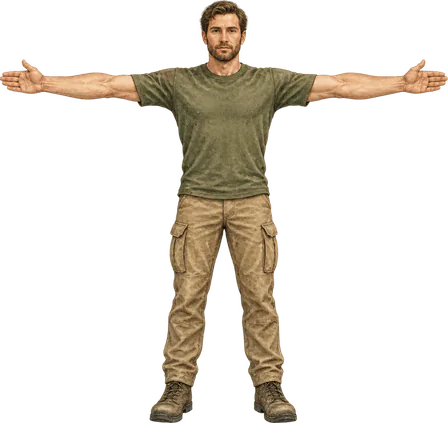
How to use it: Stand with your arms straight out, have someone measure fingertip to fingertip in inches, then drag the slider to that number.
// The calculator
28"
// The math
Draw length = arm span ÷ 2.5, rounded to a tenth of an inch. Arm span is fingertip to fingertip with your arms straight out, in inches. It’s the standard shop method.
Bow length (recurve, AMO) follows the draw: up to 26″ → 64″ bow, up to 28″ → 66″, up to 30″ → 68″, longer → 70″. Arrow length is your draw plus 1″, to the nearest half inch.
A 70″ arm span: 70 ÷ 2.5 = 28″ draw. That’s a 66″ bow and 29″ arrows.
The full explanation: How to measure your draw length at home.
// FAQ
Quick answers about measuring, rounding and when to re-check.
It decides your bow length, your arrow length and your real draw weight. Limbs are rated at 28″, so a longer draw pulls heavier than the label.
Round down if you’re between sizes. A slightly short draw is easier to learn on than one that over-extends your bow arm.
A little. Most beginners gain half an inch as their anchor and back tension improve. Re-check after a few months.
// More tools
// Follow
// Free printable
Seventeen printable pages: session log, score tracker, a 30-day drill challenge, a bow maintenance card, a first-season checklist and more. Join the monthly email and it lands right away.