

- Quick estimate: measure your arm span and divide by 2.5 (a 70-inch span gives about 28 inches).
- Confirm it at full draw, at your real anchor, before you buy a compound or cut arrows.
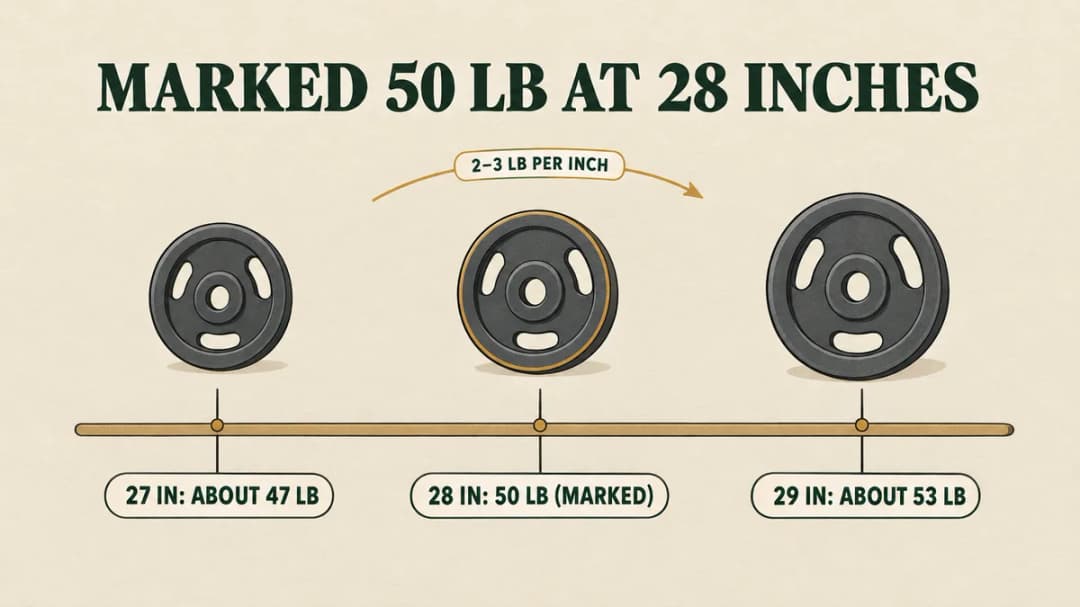
- On a recurve, draw weight changes about 2–3 lb per inch away from the 28 inches it’s marked at.
- A compound must be set to your draw length; never set it longer to chase speed.
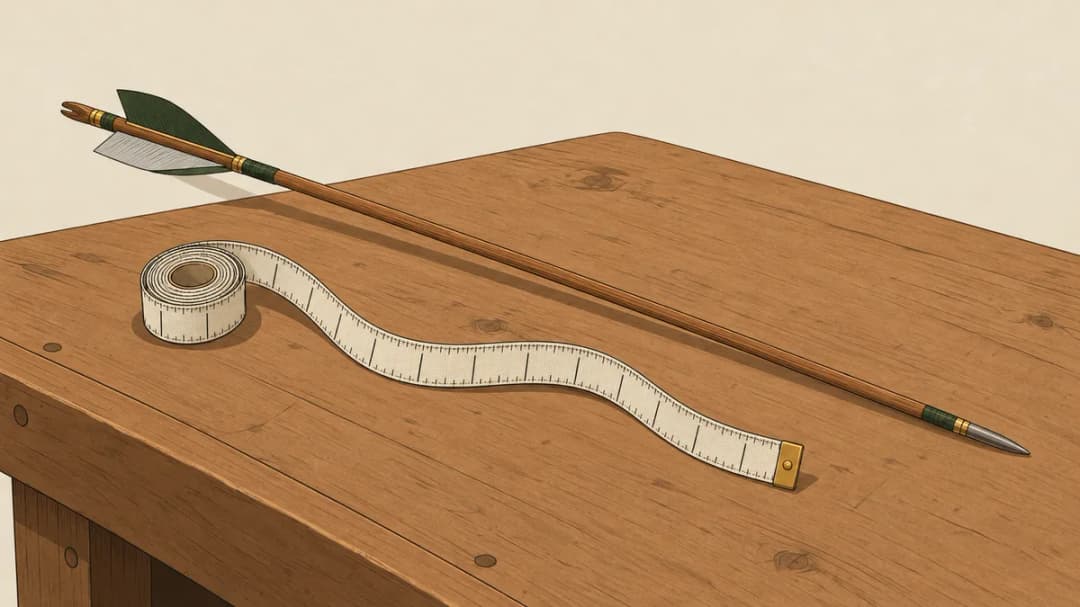
- Arrows run about an inch longer than your draw, so the point never comes behind the rest.
Your bow feels awkward at full draw, your anchor wanders, and the shop keeps asking for a number you’ve never measured. 😬
Draw length is how far you pull the string back at full draw, and you can estimate it tonight: measure fingertip to fingertip and divide by 2.5, or run the draw length calculator. Then confirm it at full draw, and your bow, arrows and anchor finally fit you. 👍
What your draw length decides on your bow and arrows
One number decides how much weight you hold, how long your arrows need to be and where your anchor sits. Get it wrong and every other choice is built on a bad measurement.
Bow makers and charts all use one standard way to measure it, and it isn’t the length of your arrow. This one-minute video shows how a shop gets there.
Here’s the Archery Trade Association’s definition, as the Bowhunters United video gives it:
The Archery Trade Association measures draw length from the nocking point to the pivot point of the bow, which is the deepest part of the grip, plus 1 and 3/4 in.
That extra 1¾ inches is why your draw length isn’t your arrow length, and why a chart number can look long next to your arrows. Use the draw length for the bow, and let the shop cut arrows from it.
If you don’t pull to the same spot every time, the number changes from shot to shot. That was one of my first mistakes:
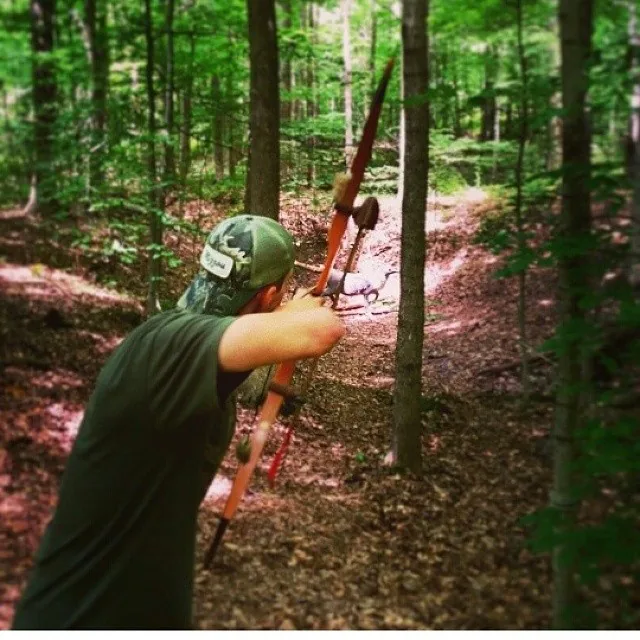
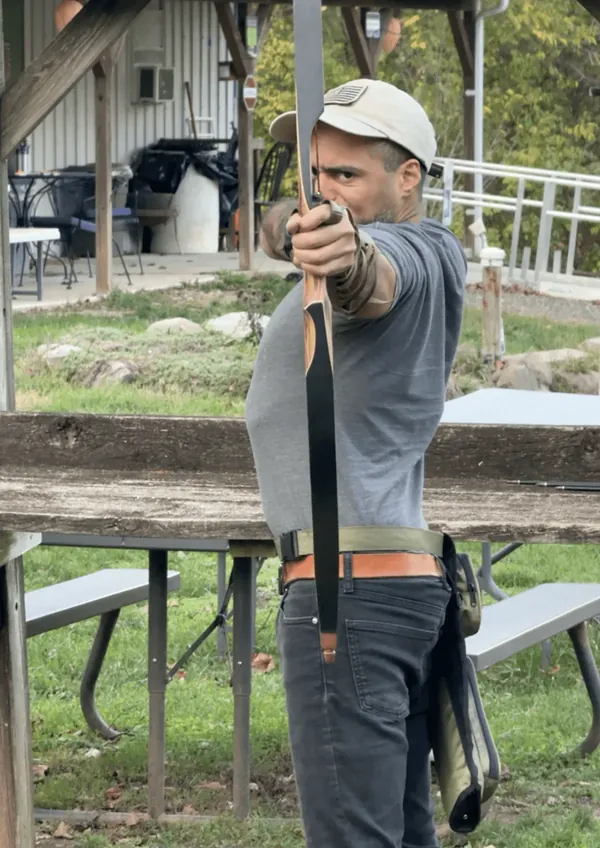
A mistake I made a lot before noticing it was that I was supposed to pull all the way to my cheekbone and I wasn't doing that.
Measure at the anchor you’ll really use, not a half draw. A short, inconsistent draw gives you a number that’s too small.

// Free printable
Get the range log I actually use.
Seventeen printable pages: session log, score tracker, a 30-day drill challenge, a bow maintenance card, a first-season checklist and more. Join the monthly email and it lands right away.
How to measure your draw length: the arm span method
You only need a tape measure and a friend. This gives a good starting number, which a shop can confirm at full draw.
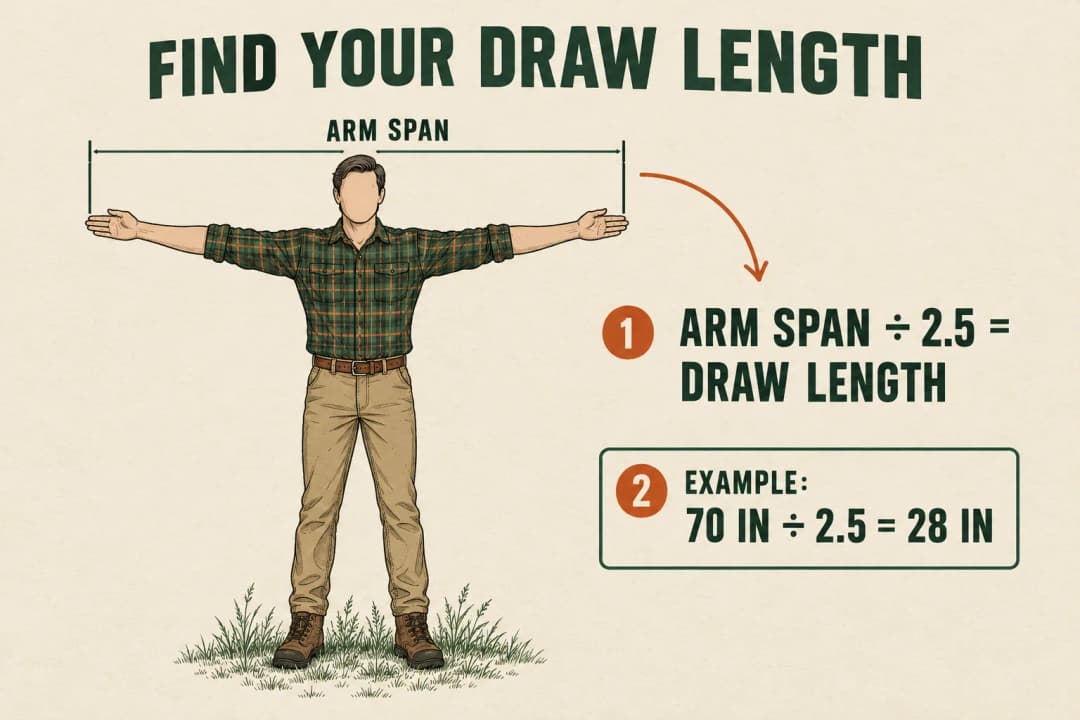
- Stand tall with your arms straight out to the sides, palms forward, like a T.
- Measure from the tip of one middle finger to the other.
- Divide by 2.5. A 70-inch arm span gives 70 ÷ 2.5 = 28 inches.
Body proportions vary, so treat it as an estimate. The draw length calculator does the sum for you.
| Arm span | Estimated draw length |
|---|---|
| 62.5 in | 25 in |
| 65 in | 26 in |
| 67.5 in | 27 in |
| 70 in | 28 in |
| 72.5 in | 29 in |
| 75 in | 30 in |
Still choosing the bow itself? The bow quiz matches you to a bow type and a starting draw weight.
Confirm it at full draw: the marked-arrow check
Arm span gets you close; your real draw is what you do at anchor. A shop checks it with a long arrow marked in inches, drawn on a light bow to your anchor.
- Use a light bow you can hold at anchor for a few seconds without shaking.
- Draw a long, marked arrow (a draw-check arrow) to your normal anchor and hold.
- Have a helper read the mark at the front of the riser, then let down slowly; never release it.
- Do it three times and use the number you hit most often.
That’s the same order a shop follows, as the Bowhunters United video describes:
They might also have you draw back a lightweight bow with a measuring arrow on it to get an even more accurate estimate. Then, you’ll try out a few different draw lengths until you find your exact draw length.
The last step matters most on a compound. Shooting two or three settings tells you more than any tape measure, so if a shop offers it, say yes.
Draw length on a recurve or longbow: it changes your draw weight
Traditional bows are marked with their weight at a 28-inch draw. Pull less and you hold less weight; pull more and you hold more.
Most recurves change by about 2–3 lb for every inch away from 28 inches. A bow marked 50 lb pulls roughly 47 lb at 27 inches and 53 lb at 29 inches.
Draw length on a compound: the bow is set to you
A compound has a fixed draw length, set by its cams or a module, so it stops at a solid back wall. It has to match your draw length, and a shop can adjust most bows in a few minutes.
- Too long: you lean back or stretch to reach the wall, and your anchor wanders. Field & Stream’s test groups nearly doubled at 60 yards with a draw just 1 inch too long.
- Too short: you feel cramped and give up some speed, roughly 10 fps per inch.
Signs your draw length is wrong
Your body tells you before the tape measure does. If you see two or more of these, have your draw checked.
| What you notice | Likely problem | What to do |
|---|---|---|
| Leaning back or reaching to hit the compound’s wall | Set too long | Have the shop shorten it |
| Bow arm bent and elbow cramped at full draw | Set too short | Have the shop lengthen it |
| String slapping your forearm on every shot | Often too long, or a locked elbow | Check draw length, then your bow arm |
| Your anchor lands in a different spot each shot | An inconsistent draw | Measure at your real anchor, then practice it |
Draw length and arrow length
Your arrows are cut to suit your draw length. They must be long enough that the point never comes back past the arrow rest or the shelf.
A common rule of thumb is about an inch longer than your draw length, and a shop will cut them for your setup. Remember that longer arrows act weaker in spine.
// FAQ
Frequently asked questions
Quick answers to the questions readers ask most.
How do I find my draw length at home?
Measure your arm span fingertip to fingertip with your arms out, and divide by 2.5. Have a shop confirm it at full draw.
What is the average draw length?
There isn’t a useful average, because it follows your arm span: a 70-inch span works out to about 28 inches. Measure yours rather than guessing.
Does draw length change draw weight on a recurve?
Yes, by about 2–3 lb per inch away from the 28 inches the bow is marked at.
Can you change a compound bow’s draw length?
Most compounds can be adjusted with a module or cam setting. A shop can set it to you and check it at full draw.
Does my draw length change as I get better?
It can, a little, as your anchor and back tension settle. Recheck it after your first few months and before you buy a compound.
Final thoughts
Draw length is the measurement everything else is built on: your weight, your arrows and your anchor. Measure your arm span tonight and confirm it at full draw before you spend money.
Write your number in the free range log, so it’s there when you buy arrows or limbs.