
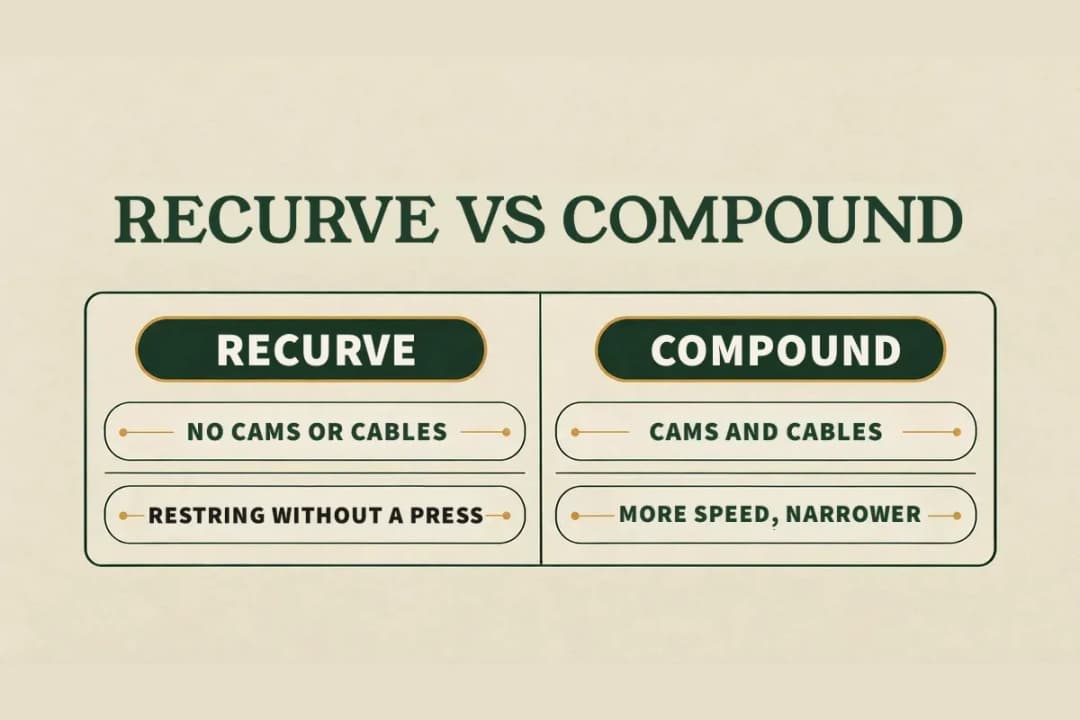


- For a first crossbow, buy a compound: it shoots faster from a lighter draw weight and is far narrower when cocked than a recurve.
- The TenPoint Siege RS410 is my best overall pick, because its built-in ACUslide crank both cocks and de-cocks it.
- The Barnett Recruit XP is the light, simple value pick at about 6 lb and a 125 lb draw weight.
- The Killer Instinct LOGIX 435 comes with a crank and a let-down trigger box, so you can unload it without taking a shot.
- Choose by cocking, width and weight before speed: over 300 fps is already plenty for deer inside 35 yards.
short on time? start here
The three picks
The verdict first: buy the compound crossbow you can cock, carry and de-cock easily, not the fastest one on the shelf. 😅 Speed sells on the box; ease is what gets you practicing.
Below are three picks for a first deer season. Still deciding between bow types? My guide to choosing a crossbow starts one step earlier. 👇
Why a compound crossbow suits most beginners
A compound crossbow bends its limbs through cams and cables, the same idea as a compound bow. The cams let it store more energy from a lower draw weight, so it can shoot fast without the very heavy limbs a recurve crossbow needs for the same speed.
The other big win is width. A compound’s limbs sit close together when it’s cocked: the Killer Instinct LOGIX 435 is listed at 6.75″ axle to axle when cocked, while Excalibur’s Mag 340 recurve is listed at 22″. That gap matters in a ground blind or a treestand.
Death by Bunjie, a long-running crossbow hunting channel, went shopping for a new crossbow after years with a recurve. Listen to what suprised him about modern compounds:
I am amazed at how the difference between compounds and recurves has diminished.
I agree, and it’s the main reason I point first-time buyers to a compound. The old recurve advantages, an easy uncock and field repairs, are mostly matched now: many compounds de-cock with a crank or a let-down trigger. But the one edge a recurve keeps is a string you can swap without a bow press, so a hunter far from a shop should still look at the best recurve crossbows.
And he put the speed and noise difference plainly:
Your compound crossbows offer greater speeds and your compound crossbows are typically quieter than your recurve crossbows.
Quieter I’ll take every time, because a deer that jumps the string turns a good shot into a bad one. Faster is the part I’d stop chasing. More on that in the checks below.
Best compound crossbows for beginners: 3 picks compared
These picks come from maker specs, independent reviews and owner reports, not my own shooting, so check each one against your state’s rules and your own build before you buy.
Affiliate links: I may earn a commission at no extra cost to you.
| Crossbow | Design | Listed speed | Draw weight | Listed weight | Width cocked | Cocking |
|---|---|---|---|---|---|---|
| TenPoint Siege RS410 | Reverse-draw compound | 410 fps (400 gr bolt) | 220 lb | 7.5 lb | 7.5″ | Built-in ACUslide crank, cocks and de-cocks |
| Barnett Recruit XP | Compound | 330 fps | 125 lb | 6 lb | 13″ | Rope cocker included |
| Killer Instinct LOGIX 435 | Compound (X Cam) | 435 fps | 210 lb | 7.9 lb | 6.75″ | Crank included, let-down trigger box |
1. Best overall for beginners: TenPoint Siege RS410

TenPoint Siege RS410
TenPoint Siege RS410 Crossbow Package ACUslide Graphite Grey
by TenPoint
Affiliate link: I may earn a commission, at no cost to you.
Key features
- Reverse-draw crossbow: 410 fps, 26.5″ long, 7.5″ wide cocked
- Built-in ACUslide crank cocks it and de-cocks it without a shot
- 13.5″ power stroke and a 3.5 lb two-stage trigger; about 7.5 lb
- Made for TenPoint bolts: check the length, nock and weight
Specs
- Brand
- TenPoint
- Model
- CB21012-1819
- Color
- Graphite
- Length
- 1 inches
- Weight
- 16.8 pounds
The Siege RS410 is a compact reverse-draw compound: TenPoint lists it at 26.5″ long without the stirrup and 7.5″ wide when cocked. Its ACUslide crank is built into the stock, and you can back-wind it to de-cock the string under control, with no bolt shot into a target.
- 410 fps and 149 ft-lb with the included 400-grain bolt (maker’s figures)
- 220 lb draw weight and a 13.5″ power stroke
- 7.5 lb without accessories
- Reverse-draw limbs that keep the weight close to your grip
Pros
- Cocking and de-cocking with one built-in crank, no strength needed
- Very narrow when cocked, easy in a blind
- Balanced toward your hands, so it’s steadier to hold
Cons
- The heaviest of these three on paper
- Uses TenPoint’s short 16″ bolts, so check what your local shop stocks
- Costs far more than the other two
Who it’s for
It’s for the beginner who wants one crossbow for years and hates the idea of shooting a bolt just to unload. If cocking strength or safe de-cocking worries you, start here. Read my reverse-draw crossbow guide for how the design balances.
2. Best value: Barnett Recruit XP

Barnett Recruit XP
Barnett Recruit XP Crossbow Package, Compact Crossbow with 2 Arrows & 3 Dot Sight, Ideal for Hunting & Training for All Ages & Capabilities
by BARNETT
Affiliate link: I may earn a commission, at no cost to you.
Key features
- Compact compound crossbow rated at 330 fps, with a light draw
- Anti-dry-fire trigger and a bristle retainer that holds the bolt
- Kit: 3-dot sight, side quiver, two 20″ arrows, rope cocker and wax
- Ships mostly assembled; buy spare bolts in the same length and nock
Specs
- Brand
- BARNETT
- Model
- BAR78184
- Size
- Recruit XP w/Rope Cocking Device
- Color
- Gray
- Length
- 32.25 Inches
- Weight
- 9.7995475459 pounds
Barnett lists the Recruit XP at 330 fps from a 125 lb draw weight, and Archery Business measured 327 fps with a 400-grain arrow. At about 6 lb and with a light draw for a compound, it’s the easiest of these three to carry and cock by rope. Barnett’s listing also names an anti-dry-fire trigger and a bristle arrow retainer.
- 330 fps listed, 92 ft-lb of kinetic energy
- 125 lb draw weight, 13.6″ power stroke
- About 6 lb, 13″ wide when cocked
- Package: 3-dot sight, side quiver, two 20″ bolts and a rope cocker
Pros
- Light enough for smaller or younger shooters
- A rope cocker roughly halves an already light pull
- Anti-dry-fire trigger as standard
Cons
- The slowest pick here, so keep shots close
- A dot sight, not a magnified scope
- No built-in de-cocking: you unload by shooting a bolt into a target
Who it’s for
It suits a first-season hunter who keeps shots inside 30–35 yards and wants something light. Pair it with a proper crossbow scope later if you find the dot sight limits you.
3. Best for safe unloading: Killer Instinct LOGIX 435

Killer Instinct LOGIX 435
Killer Instinct LOGIX 435 Crossbow Package with DSC Cranking Device - 435 FPS LET-Down DE-Cocking Triggerbox with X CAM System and Illuminated 4x32 Scope
by Killer Instinct
Affiliate link: I may earn a commission, at no cost to you.
Key features
- 435 fps crossbow with a 210 lb draw weight and X-cam limbs
- Dead Silent Crank included, so cocking takes little effort
- Let-down trigger box: unload it at the end of the day without firing
- Kit: lit 4×32 scope, three 20″ bolts, rope cocker, quiver, rail lube
Specs
- Brand
- Killer Instinct
- Color
- Tan/Black
- Weight
- 8 pounds
The LOGIX 435 is the fast one: 435 fps listed from a 210 lb draw weight, with a 56% let-off Killer Instinct says makes cocking easier. The let-down trigger box is why it’s on this list: it lets you de-cock without shooting, and the package includes a crank.
- 435 fps listed, about 155 ft-lb of kinetic energy
- 210 lb draw weight with a 15″ power stroke
- 6.75″ wide cocked, 10.75″ uncocked
- Package: illuminated 4×32 scope, crank, rope cocker, quiver and three 20″ 390-grain bolts
Pros
- De-cock without a shot or a discharge target
- Crank in the box, so no hard rope cocking
- The narrowest of these three when cocked
Cons
- About 7.9 lb before you add anything
- More speed than a beginner’s shots need
- Specs come mostly from retailer listings
Who it’s for
It’s for a hunter who sits long days and wants to unload at dark without hunting for a safe backstop. Learn the let-down steps at home first, with the manual open.
How to choose a compound crossbow: 5 checks before you buy
Every compound on the shelf will kill a deer at sensible ranges. The checks that matter for a beginner are the ones you live with every time you shoot.
- Cocking: can you cock it every time? A rope cocker roughly halves the pull; a crank turns it into a slow, easy wind.
- De-cocking: a crank that de-cocks or a let-down trigger saves you shooting a bolt at the end of every sit.
- Width: narrower is easier to swing in a blind or treestand; compare the cocked figure, not the uncocked one.
- Weight: add a scope, quiver and bolts to the listed weight; my guide to how heavy a crossbow is has real numbers.
- Bolts: note the length, nock and minimum weight, then stock up from bolts that match.
Check the law too. Crossbow seasons, permits and minimum draw weights differ by state, so start with my state crossbow hunting regulations overview, then your state agency.
Not sure a crossbow is even the right first bow for you? The bow quiz ranks every bow type for your body, budget and state.
The video below is the one quoted above, if you’d like to hear the full compound-or-recurve debate.

// Free printable
Get the range log I actually use.
Seventeen printable pages: session log, score tracker, a 30-day drill challenge, a bow maintenance card, a first-season checklist and more. Join the monthly email and it lands right away.
Compound crossbow safety: dry fires and fingers
A compound crossbow stores a lot of energy in its cams and limbs. Never let it go without a bolt on the string, and never let your fingers rise above the rail.
I learned what a dry fire means with my own bow at the range, not with a crossbow. Nobody had to tell me twice afterward.
That’s not what you do with a bow, and I learned that that is a big no-no. I can break the bow, you know.
All three picks list an anti-dry-fire trigger or let-down system, but treat those as backups, not permission. My guide to loading a crossbow safely covers the habit step by step.
// FAQ
Frequently asked questions
Quick answers to the questions readers ask most.
Is a compound or recurve crossbow better for a beginner?
A compound, for most people: it’s narrower, quieter and faster from a lighter draw weight. Choose a recurve only if you need to restring it in the field without a bow press.
How fast should a beginner’s crossbow be?
Over 300 fps is plenty for deer inside 35 yards. Heavier bolts and good shot placement matter more than the last 50 fps.
Can I cock a compound crossbow by hand?
Some light ones, but use a cocking aid every time. A rope cocker or crank pulls the string back evenly, which keeps your shots consistent.
How do I unload a compound crossbow?
Shoot a bolt into a safe target, or use a de-cocking crank or let-down trigger if your crossbow has one. Never dry-fire it; my post on how long you can leave a crossbow cocked explains why it matters.
Do compound crossbows need a bow press?
Changing the string or cables usually does. Have a pro shop do it unless your maker sells a press for your model.

Final thoughts
The best compound crossbow for a beginner is the one you can cock, carry and unload safely, every time. Start with the Siege RS410 if the budget allows, the Recruit XP if light and simple matter most, or the LOGIX 435 if you want to de-cock without a shot.
Whichever you buy, log your groups at each distance as you sight it in. My free range log has the pages for it.
