

- Most modern hunting crossbows are listed at about 6 to 8 lb bare; pistol crossbows weigh about 2.5–3 lb.
- The listed number usually leaves out the scope: Outdoor Life measured a 6.9 lb TenPoint Venom X at 8.11 lb with its scope on.
- Plan on the ready-to-hunt weight, scope, quiver and bolts included, not the number on the box.
- Don’t chase the lightest crossbow: a little weight, balanced near your hands, holds steadier offhand.
You’re comparing crossbows, and the spec sheets swing from under 5 lb to almost 10 once a scope goes on. 😬
A typical hunting crossbow weighs 6–8 lb bare and roughly 7–10 lb ready to hunt, and that difference decides how far you’ll carry it and how steady you’ll hold it. Below are real weights for ten models by type, plus how to pick the right weight when you choose your crossbow. 👇
How heavy is a crossbow? Real weights by type
These are the makers’ and retailers’ listed weights, plus weights measured with a scope where a tester published one. Read the first number as a floor: almost nobody hunts with a bare crossbow.
| Crossbow | Type | Listed weight | With scope or accessories |
|---|---|---|---|
| Ballista BAT | Pistol (compound) | About 2.5–3.2 lb (listings disagree) | Not published |
| Excalibur Mag Air | Recurve | 4.9 lb | 6.7 lb with scope, quiver and bolts |
| Excalibur Mag 340 | Recurve | 5.5–6 lb | 8 lb with accessories |
| Barnett Recruit XP | Compound | About 6 lb | Not published |
| Wicked Ridge Invader 400 | Compound | 6 lb | Not published |
| Ravin R26 | Compound (narrow) | 6.5 lb | Not published |
| TenPoint Venom X | Compound | 6.9 lb | 8.11 lb measured with scope |
| TenPoint Siege RS410 | Reverse-draw compound | 7.5 lb | Not published |
| Killer Instinct LOGIX 435 | Compound | 7.9 lb | 8.4 lb for the version with a fitted crank |
| TenPoint Flatline 460 | Compound | 7.5 lb | 9.7 lb measured with scope |
Pistol crossbows: about 2.5–3 lb and one-handed, made for targets and pests, not deer. Many states ban them for big game, so check before you buy one for hunting.
Recurve crossbows: no cams, so the bare bow is often the lightest of the hunting types. Excalibur lists its Mag Air at 4.9 lb, but recurves are wider, so they feel bigger than they weigh; see my best recurve crossbows.
Compound crossbows: the 6–8 lb middle of the market. Speed and a built-in crank push the weight up, which is why the 460 fps Flatline sits near the top; compare picks in my best compound crossbows.
Reverse-draw crossbows: not lighter on the scale, but the limbs sit back near your grip, so they feel lighter in your hands. My best reverse-draw crossbows covers the design.
Why the listed weight is too low: scope, quiver and crank
A spec sheet usually lists the crossbow “without accessories”. Everything you bolt on before the hunt goes on top of that number.
- Scope: Outdoor Life’s scales put the TenPoint Venom X at 8.11 lb with its scope against a listed 6.9 lb, and the Flatline 460 at 9.7 lb against 7.5 lb.
- Crank: the LOGIX 435 kit with a fitted crank is listed at 8.4 lb, half a pound over the standard 7.9 lb kit.
- Quiver and bolts: a loaded quiver rides on the crossbow all day.
- Sling and lighted nocks: small, but they add up.
So add about 1–2 lb for a scope and a loaded quiver to whatever the box says. That’s the crossbow you’ll actually carry.
Why crossbow weight matters: carrying, holding and balance
Weight matters in three places: on the walk in, at full hold and in your hands as the crossbow points forward. Each one pulls in a different direction.
Carrying it to the stand
TenPoint points out that most whitetail hunters carry a crossbow slung over a shoulder on a short walk to a stand or blind. For that hunter, a pound either way hardly matters. For a long walk in, weight matters more; a good crossbow sling helps either way.
Holding it steady for the shot
Dan Schmidt of Deer and Deer Hunting has shot a lot of crossbows for the magazine’s TV show. His third tip for choosing one is about weight, and it goes against the ads:
A lot of the emphasis in some of the ad copy for all the crossbow companies is lighter is better. I don’t think so. You have to have a little bit of juice to it.
I agree with him. A very light crossbow moves with every heartbeat when you hold it offhand, and every wobble shows up at 30 yards.
He says why the extra weight helps him:
I like to say it’s a little bit meaty. And for me, the accuracy, if I’m holding it freehand in a treestand, it gives me plenty of stability.
The crossbow he’s holding is a 7.2 lb TenPoint, so “meaty” still means a normal hunting weight, not a heavy one. My take: don’t pay extra for the lightest model unless you walk a long way or you’re a smaller shooter. If you shoot from a rest, weight matters even less: TenPoint notes most crossbow hunters use a tripod, shooting sticks or a rail in the stand.
Balance: where the weight sits
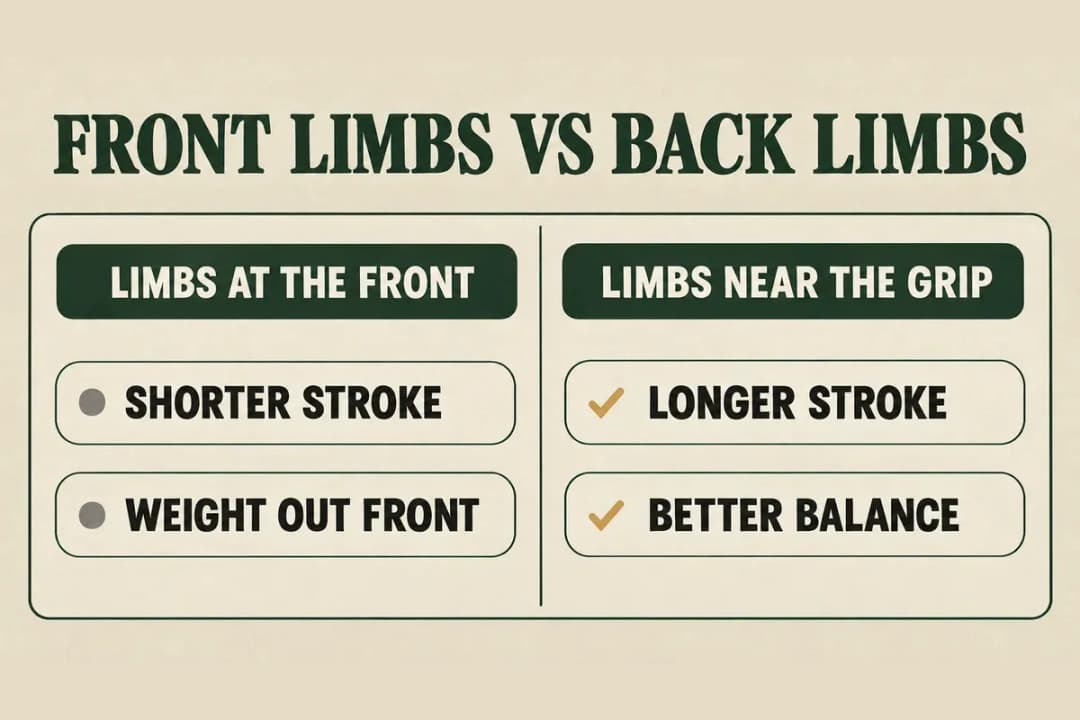
Two crossbows with the same weight can feel very different. Limbs at the front put the weight out front, which pulls the muzzle down when you hold it.
Reverse-draw crossbows move the limbs back near the grip. That gives a longer power stroke and better balance in your hands, which is why a 7.5 lb reverse draw like the Siege RS410 can feel lighter than its number.
// Free printable
Get the range log I actually use.
Seventeen printable pages: session log, score tracker, a 30-day drill challenge, a bow maintenance card, a first-season checklist and more. Join the monthly email and it lands right away.
How heavy should your first crossbow be?
For most first-time hunters I’d aim for a crossbow listed at about 6–7.5 lb, or 7.5–9 lb with its scope. That’s light enough to carry and heavy enough to hold steady.
- Smaller or younger shooters: start near 6 lb listed, like the Barnett Recruit XP, and check the stock length.
- Long walks or hunting from the ground: favor the lighter end and a padded sling.
- Treestand or blind sitters: weight matters less, so choose on balance, width and cocking.
- Anyone who shoots from a rest: a heavier, faster crossbow is fine; the rest carries it.
The video below is Dan Schmidt’s full list of five things to look for, from weight to speed and size.
// FAQ
Frequently asked questions
Quick answers to the questions readers ask most.
What is the average weight of a crossbow?
Most hunting crossbows are listed at about 6–8 lb without accessories. With a scope and quiver, expect roughly 7–10 lb.
How much does a pistol crossbow weigh?
About 2.5–3 lb. They’re for targets and small pests, not deer, and many states ban them for big game.
Is a heavier crossbow more accurate?
Not by itself, but a little weight can make it steadier to hold offhand. Balance and a good rest matter more than the number.
How much weight does a scope add to a crossbow?
Outdoor Life’s measurements show about 1.2 lb for the TenPoint Venom X’s scope and more for bigger optics. Higher-end and rangefinding scopes weigh more.
Are reverse-draw crossbows lighter?
Not always on the scale, but they balance closer to your hands, so they feel lighter. My reverse-draw crossbow guide compares a few.

Final thoughts
A crossbow weighs what it weighs with the scope on, so judge every model by its ready-to-hunt weight and its balance. For most first crossbows, 7.5–9 lb ready to hunt is the sweet spot.
Once yours is set up, sight it in and track your groups. My free range log has the pages for it.