

- Check your state’s rules first: seasons, permits and minimum draw weights for crossbows differ from state to state.
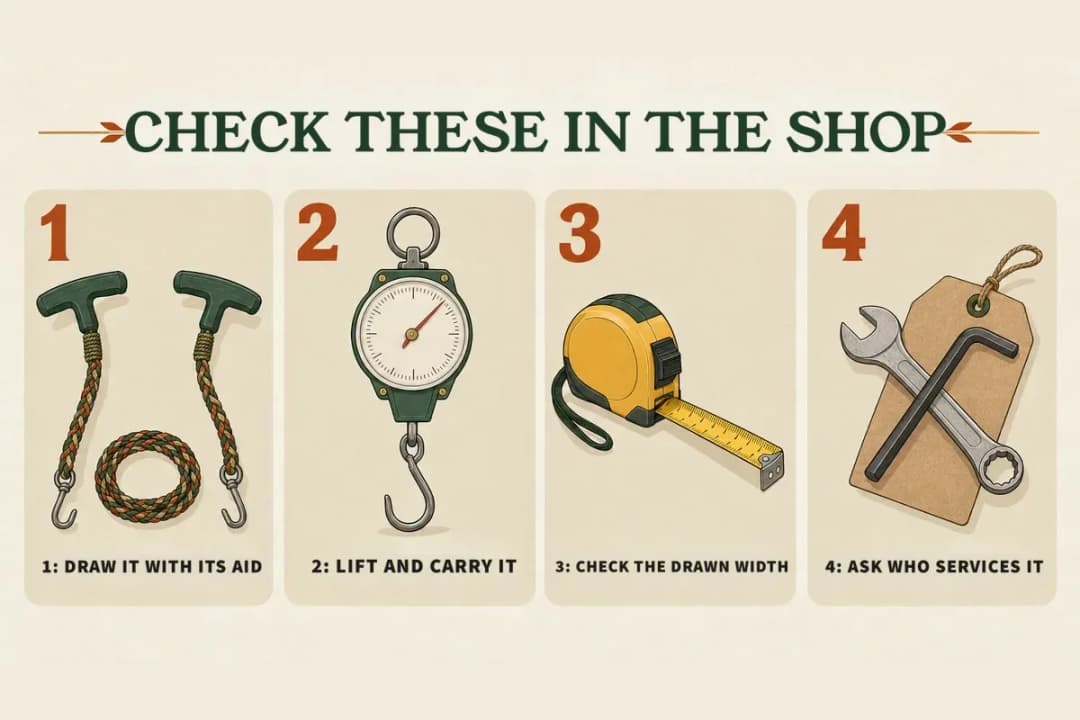
- Pick by how easily you can cock it: a rope aid roughly halves the pull, and a crank makes it slow but easy.
- Lift it before you buy, with a scope on: most hunting crossbows land between 6 and 10 lb ready to hunt.
- Speed is a tiebreaker, not a goal: over 300 fps is plenty for deer inside 35 yards.
- For most first-time buyers, a narrow compound with a crank is the right answer.
Myth: the biggest fps number on the box is the best crossbow. 🙄
Truth: choose the crossbow you can legally hunt with, cock every time and carry all day, then let speed break a tie. A fast crossbow you can’t cock in the cold is just a heavy stick. Work through the seven checks below and you’ll know exactly which crossbow picks to look at.
How to choose a crossbow: start with the law and your hunt
Before you compare models, find out where and when you can use one. Crossbow rules are set state by state, and they change: New York, for example, only opened its full archery season to crossbows in 2025.
Then picture your hunt. A treestand, a ground blind and a long walk in each favor a different crossbow: narrow for the blind, light for the walk, balanced for the stand.
1. Check your state’s crossbow rules
Look up the season dates, any permit and the minimum draw weight or bolt rules for your state. My state crossbow regulations overview is a starting point; your state wildlife agency has the final word.
2. Pick the type: recurve, compound or reverse draw
There are three main designs, and the type decides the width, the weight and how you maintain it. My types of crossbows post goes deeper; heres how three real models compare on their listed specs.
| Type | Example | Width cocked | Listed weight | Listed speed | Upkeep |
|---|---|---|---|---|---|
| Recurve | Excalibur Mag 340 | 22″ | 5.5–6 lb (8 lb with accessories) | 340 fps | No cams; string changes without a press |
| Compound | Barnett Recruit XP | 13″ | 6 lb | 330 fps | Cams and cables; a shop changes strings |
| Reverse-draw compound | TenPoint Siege RS410 | 7.5″ | 7.5 lb | 410 fps | Cams and cables; built-in crank |
For most first-time buyers I’d pick a compound, because it’s narrower and quieter for the same speed. Compare picks in my best compound crossbows, best recurve crossbows and best reverse-draw crossbows roundups.
3. Match the cocking to your strength
Draw weights of 125–270 lb are normal on hunting crossbows, so nobody should cock one by hand. The real question is which aid you’ll use every single time.
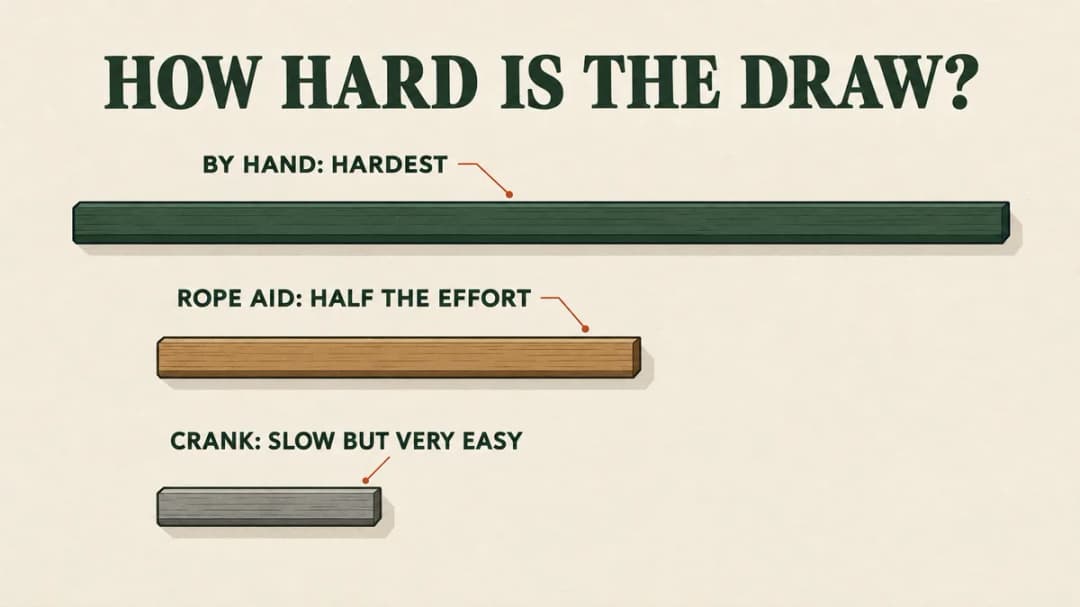
- By hand: the full draw weight, the hardest way, and uneven pulls hurt accuracy.
- Rope aid: makers say it cuts the effort roughly in half.
- Crank: slow, but very easy; some cranks also de-cock the string.
Knetters Practical Outdoors, a Michigan deer hunter who has shot deer with budget crossbows, gives a fair warning about rope cocking:
Cocking ropes are quick and simple to use but they do require a certain level of upper body strength.
He adds that shorter shooters lose strength as the rope comes up toward the neck, and I’d take that seriously. If you can’t rope-cock it ten times in a row, buy a crank; tired cocking is uneven cocking.
4. Lift it: weight and balance
Listed weights usually leave out the scope and quiver, and those add a pound or more. Plan on the ready-to-hunt weight, and see my guide to how heavy a crossbow is for real numbers by type.
5. Measure the width when cocked
The cocked width, axle to axle, is what you swing in a blind window. Compare that figure, not the uncocked one: compounds and reverse draws are often under half the width of a recurve.
6. Treat speed as a tiebreaker
Most modern hunting crossbows already shoot over 300 fps. Shot placement, a matched bolt and knowing the distance kill deer, not the last 50 fps.
The same video puts the speed question to rest for most hunters:
If you plan on keeping those shots to say 35 yards or less a crossbow that shoots over 300 ft per second is more than fast enough.
I’d hold a beginner to that 35-yard limit anyway. Inside it, a 330 fps crossbow and a 430 fps one hit the same deer, and the slower one is usually lighter on your shoulder and your budget.
His warning about long shots is the part most buyers skip:
It’s not just about shooting accurately at these distances it’s also being able to know the distance.
That’s why a rangefinder is worth more to a new hunter than extra speed. My ethical shot checker tells you whether your setup and your shot are ready for the animal.
7. Check safety features, the scope and the bolts it takes
Look for an anti-dry-fire trigger, finger guards and an automatic safety. Then read the bolt page of the manual: the length, nock style and minimum weight decide which crossbow bolts you can buy.
- Safety: anti-dry-fire trigger, finger guards, a safety that sets itself when cocked.
- Scope: multiple aiming points for set distances; upgrade later with a crossbow scope if the package one is weak.
- Bolts: the maker’s length, nock and minimum weight, point included.
- Fit: an adjustable stock if you’re shorter or wear thick layers.
Try a crossbow in a shop before you buy
But a spec sheet can’t tell you how a crossbow sits on your shoulder or whether you can cock it. Handle two or three in a shop, and cock each one with its own aid, before you order anything online.
That’s the same advice I give for any first bow, even though I link to plenty of gear:
I don't recommend necessarily getting a bow online, to be honest, even though I have an affiliate link for a bunch of this stuff. I actually think that you should go to a shop and get it fitted properly.
A shop also handles string and cable changes on compound crossbows later. Ask who services the model before you pay for it.
Prefer to watch? This video covers price, speed, scopes, cocking and limb design for a first crossbow.
Still deciding whether a crossbow is the right first bow at all? Take the bow quiz: it ranks every bow type for your body, budget and state.
Common first-crossbow mistakes to avoid
Most regrets come from buying on the box instead of the hunt. Avoid these and your first crossbow will last you years.
- Buying the fastest crossbow you can afford, then struggling to cock it.
- Ignoring the scoped, loaded weight you’ll carry and hold.
- Buying bolts before reading the manual’s length, nock and minimum weight.
- Skipping a cocking aid “just this once”.
// FAQ
Frequently asked questions
Quick answers to the questions readers ask most.
What draw weight should my first crossbow have?
Whatever your state requires as a minimum, then the lightest model that meets your speed needs. Around 125–220 lb is common on hunting compounds, and a cocking aid makes it manageable.
Is a recurve or compound crossbow better for a first crossbow?
A compound for most people: narrower, quieter and faster for the same draw weight. Pick a recurve if you want to restring it yourself without a press; see the best recurve crossbows.
How much should a crossbow weigh?
Most hunting crossbows weigh 6–10 lb with a scope. Lighter carries easier; a little heavier holds steadier offhand.
Do I need a crank cocking device?
Not always, but if rope cocking strains you, yes. A crank is slower but makes every pull even, and some also de-cock the crossbow.
Can I use any bolts in a new crossbow?
No. Use the length, nock and minimum weight your manual lists; my best crossbow bolts guide shows how to match them.
Final thoughts
Choose your first crossbow by the law, your strength and your hunt: legal where you hunt, easy to cock, light enough to carry and narrow enough for your blind. Speed comes last.
Once it’s home, sight it in and write down every group. My free range log has the pages for that.