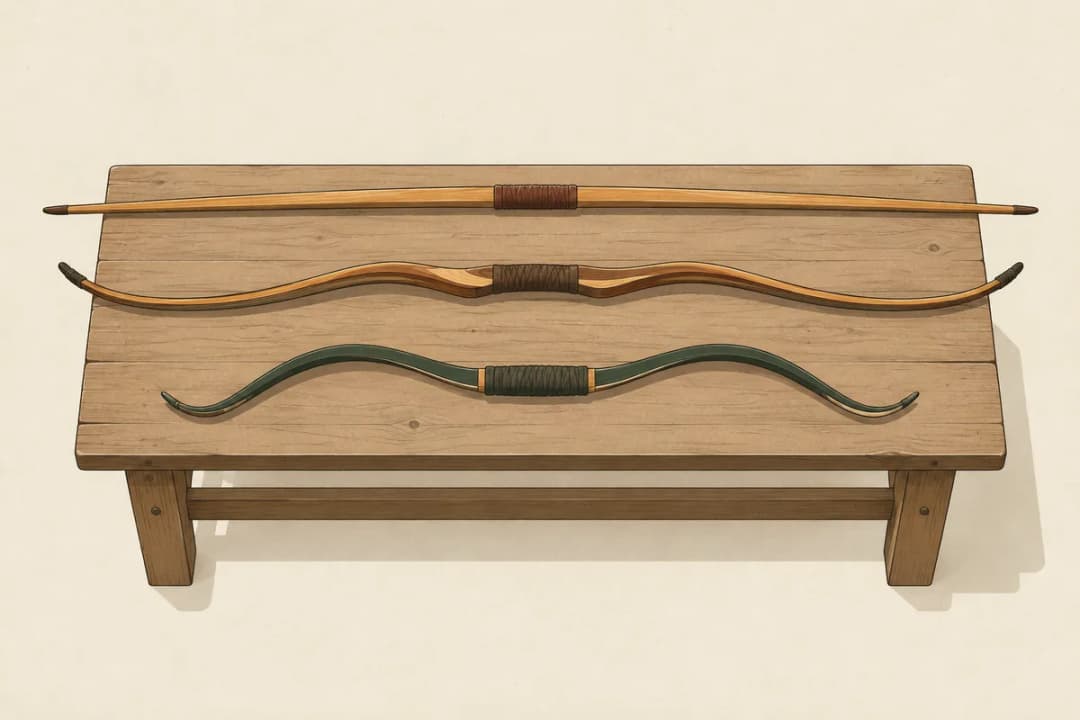


- Pick the shape for the job. Recurves are the easiest first bow, longbows reward patience, horse bows are short and fast.
- Start at 25–30 lb. Even strong adults learn form faster on a light bow. Hunting weight comes later.
- Size the bow to your draw. Wingspan ÷ 2.5 gives your draw length. Then read the chart, not your height.
Traditional archery means no sights, no cams, no release aids: just a bow, a string and your fingers. That simplicity is the appeal, but it also means the bow you choose matters more. A bow that’s too heavy or too short will fight your form on every shot. 😬
This guide is what I wish I’d known before I bought my own bow, with every source linked at the bottom so you can check my work. If you only remember one thing: buy lighter and longer than you think.
The parts of a traditional bow
Every choice in this guide comes back to a few parts. Here they are, so the rest of the page makes sense.
- 1RiserThe center handle. Holds the grip, shelf and limb bolts.
- 2GripWhere your bow hand sits. Shape changes your wrist angle.
- 3ShelfThe ledge the arrow rests on, just above your hand.
- 4LimbsThe flexing arms that store energy as you draw.
- 5TipsWhere the string sits. Reinforced tips can take modern strings.
- 6StringDacron or low-stretch. Matched to the bow’s length.
- 7Nocking pointA brass mark that sets where the arrow clips on.
- 8Brace heightThe gap from grip to string when the bow is strung.
Longbow, recurve or horse bow?
All three are traditional bows: no cams, no sights, just limbsLimbsThe flexible upper and lower arms of the bow that store the energy. Glossary →, a string and your fingers. The difference is the shape of the limbs, and that shape changes how the bow draws, how fast it shoots and how it feels in your hand.
Longbow
Long limbs that bend in one smooth curve. Quiet, simple and very old-school.
Recurve
Limb tips curve away from you, so a shorter bow stores more energy.
Horse bow
Short and sharply curved, often shot off the hand with no rest.
How the three shapes compare
| Feature | Longbow | Recurve | Horse bow |
|---|---|---|---|
| Typical length | 64–72″ | 58–70″ | 48–56″ |
| Draw feel | Smooth, slower | Smooth, more efficient | Quick, short |
| Hand shock | More | Less | Varies |
| Arrow rest | Shelf | Shelf or stick-on rest | Usually off the hand |
| Good first bow? | If you’re patient | Yes, the easiest start | For short draws |
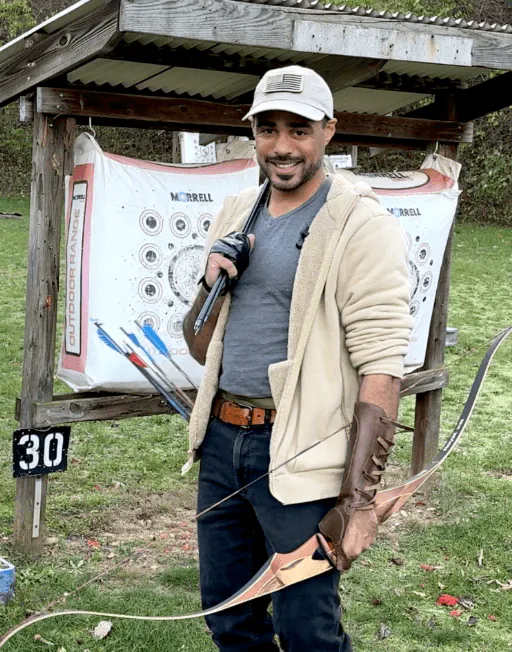
// From my range log
Why I went recurve first
“I just thought it'd look neat. I didn't give it too much thought. I like the idea of being traditional and being closer to nature, and I thought that was pretty close.”
Looks were a fine reason to pick a recurve. Picking a 45 lb one on looks alone wasn't: see the draw weight section below before you choose yours.
One-piece or takedown?
A one-piece bow is a single piece from tip to tip. A takedownTakedown bowA bow whose limbs come off the riser, for travel or for swapping to heavier limbs later. Great first bow. Glossary → splits into a riserRiserThe center section of the bow, the part you hold. The limbs attach to it. Glossary → and two limbs that bolt on. Both shoot well. The difference is what happens when you get stronger.
One-piece bow
- Simple: nothing to loosen or lose
- Often lighter and quieter in the hand
- The classic traditional look
- One draw weight, forever
- Harder to travel with
Takedown bow
- Swap limbs as you get stronger
- Breaks down to fit a pack or case
- Replace one damaged limb, not the bow
- Limb bolts to check before you shoot
- Riser can feel heavier in the hand
If this is your first traditional bow, buy a takedown. You’ll outgrow your first weight within a season or two, and limbs cost far less than a new bow. Some takedowns use ILFILFInternational Limb Fitting: a standard limb mount, so limbs from most brands fit your riser. Glossary → fittings, which opens up limbs from almost every brand.
Draw weight: start lighter than you think
Draw weightDraw weightHow many pounds of force it takes to pull the string back. Recurve limbs are usually marked at a 28-inch draw. Start lighter than you think. Glossary → is the force it takes to pull the string to a set length, usually 28″. It’s the number most beginners get wrong, and almost always in the same direction: too heavy.
- Kids, ages 8–1210–15 lb
- Teens and smaller adults15–25 lb
- Most adult beginners25–30 lb
- Coming from a compound30–40 lb
- First hunting setup40–50 lb
Traditional bows have no let-offLet-offHow much of a compound bow’s draw weight drops away at full draw, as a percentage. Glossary →. You hold the full weight at anchorAnchor pointThe spot on your face your drawing hand touches at full draw, every single shot. A consistent anchor is where consistent groups start. Glossary → on every shot, so a bow that feels fine for three arrows will wreck your form by the twentieth. Shop guides land on 25–30 lb for most adult beginners, and Wasp Archery’s trad expert ↗ suggests about 30 lb even for experienced compound shooters.
Start at 30 lb, even if you shoot a 60 lb compound. Trad muscles are different muscles.
How to measure your real draw weight at homeShow
Limbs are labeled at a 28″ draw, so your real weight depends on your own draw length.
- Hook a bow scale or luggage scale on the string at the nocking point.
- Draw straight back to your anchor, keeping the scale level with the arrow.
- Read the number at full draw. Do it three times and average.
Why the label says “@ 28 inches”Show
A bow marked 40# @ 28″ pulls 40 lb only at a 28-inch draw. Draw shorter and it’s lighter; draw longer and it’s heavier.
The rule of thumb is about 2–3 lb per inch. Some makers publish their own number, so check the bowyer’s spec before you buy.
When to move up in weightShow
Use the eight-second test: draw, hold at anchor for eight seconds, let down. Ten in a row with no shaking means you’re ready for the next step.
Move up 5 lb at a time. On a takedown that’s a limb swap, not a new bow.
What 45 pounds felt like
My first bow was 45 lb. The first time I tried to pull it, I got maybe three shots in before I was done, and when I learned I was supposed to draw all the way to my cheek, I thought: oh, I definitely can’t do this.
A resistance band around a door and months of shooting got me there. I can handle it now, but I’d still start at 40 lb, or even 35, just to get the technique down.
Fit the bow to your draw length
Bow length follows draw lengthDraw lengthHow far you pull the string back at full draw, in inches. It decides your arrow length and how much power you get from a bow. Read more →, not your height. Too short and the bow stacksStackingWhen a bow gets suddenly harder to pull in the last inches of the draw. Glossary →: the weight piles on in the last few inches. Too long and you’re carrying extra bow through the brush for nothing.
To estimate your draw length, measure your wingspan fingertip to fingertip and divide by 2.5. A 70″ wingspan works out to a 28″ draw, which is close to the adult average.
Bow length by draw length
| Your draw | Recurve (AMO) | Longbow |
|---|---|---|
| Under 26″ | 64–66″ | 64–66″ |
| 26–28″ | 66–68″ | 66–68″ |
| 28–30″ | 68–70″ | 68–70″ |
| 30″ and up | 70–72″ | 70–72″ |
Draw length also changes your real draw weight. Here’s what one bow marked at 40 lb actually pulls for five different archers:
Read it left to right: every inch you draw past 28 adds about two and a half pounds, and every inch short of it takes them away. That’s why two archers can pick up the same bow and swear it’s a different weight. Find your own bar before you buy, especially if you plan to hunt, because the two short-draw bars land under Washington’s 40 lb line.
Left or right hand? Check your eye
Traditional bows are made right-hand or left-hand, and you can’t switch later. A right-hand bow is held in your left hand and drawn with your right. Pick by your dominant eye, not the hand you write with.
- 1Make a small triangleHold both hands out at arm’s length and overlap them to make a small opening.
- 2Frame something far awayWith both eyes open, center a doorknob or light switch in the opening.
- 3Close one eyeClose your left eye. If the object stays framed, you’re right-eye dominant. If it jumps out, you’re left-eye dominant.
Right-hand bow
- Held in your left hand, drawn with your right
- For right-eye dominant archers
- Most models and limbs in stock
- Biggest used market
Left-hand bow
- Held in your right hand, drawn with your left
- For left-eye dominant archers
- Fewer models, especially used
- Some sizes ship to order
If your dominant eye doesn’t match your dominant hand, you’re cross-dominant. Many coaches suggest shooting to your eye; others have you close it. Shoot both ways at a shop or club before you buy.
Wood, glass or carbon?
Most traditional bows today are laminated: thin layers of wood glued between fiberglass or carbon. An all-wood selfbowSelfbowA bow made from a single piece of wood, with no fiberglass or carbon layers. Glossary → is beautiful, but it’s fussier about weather and about being overdrawn.
Bow materials at a glance
| Build | Feel | Durability | Cost |
|---|---|---|---|
| All-wood selfbow | Soft, slower, lots of character | Can take set; keep it dry | $$ |
| Wood + fiberglass | Smooth and reliable, the standard | Very durable | $–$$ |
| Wood + carbon | Faster, lighter, crisp | Very durable | $$$ |
Reading the laminations
Look at the edge of a laminated limb and you’ll see stripes: wood core, then glass or carbon on the back and belly. More layers usually means a smoother, more consistent bow.
Check the tips first on any used bow: that’s where lifting or cracking starts.
// Free printable
Get the range log I actually use.
Seventeen printable pages: session log, score tracker, a 30-day drill challenge, a bow maintenance card, a first-season checklist and more. Join the monthly email and it lands right away.
Grip, shelf and string
Two bows with the same weight and length can still feel completely different in your hand. These three details are why.
Grip shape
The grip sets your wrist angle, and your wrist angle decides how much you twist the bow on release. Try all three if you can.
Low wrist
Medium wrist
High wrist
Shelf and arrow rest
Most traditional bows have a shelf cut into the riser. Shoot off the shelf with a thin leather pad, or add a stick-on rest for cleaner arrow flight. A riser cut past center lets the arrow sit closer to the middle of the bow, which makes tuning easier.
String material
This one can break a bow, so check before you buy a string.
Dacron
- Works on older and all-wood bows
- Stretchy, so it’s gentle on the limbs
- Cheap and easy to find
- Slower and a little louder
Low-stretch (Fast Flight type)
- Faster arrows, quieter shot
- Holds brace height better
- Can crack tips not built for it
- Check the bowyer’s spec first
What to spend, and buying used
A good first traditional bow costs less than most people expect. The money you save goes further on arrows, a tab and lessons.
Roughly what traditional bows cost
| Tier | Price | What you get |
|---|---|---|
| Entry takedown recurve | $150–250 | Wood riser, fiberglass limbs, swap-able weights |
| Factory one-piece | $300–600 | Nicer finish, quieter, one weight |
| ILF riser + limbs | $300–700 | Mix and match limbs from many brands |
| Custom bowyer | $600–1,200+ | Built to your draw length and weight |
What to check on a used bow
Used traditional bows are a great deal when they’re sound. Look the bow over in good light before you hand over cash.
- Limb twist: string it and sight down the string. It should split both limbs down the middle.
- Laminations: no lifting, splitting or cracks, especially at the tips and where the limbs meet the riser.
- String grooves: smooth at both tips, with no frayed or cut string.
- Marked weight and length: written on the riser or limb. Then measure at your own draw.
- Dry-fired? Ask. If the seller says yes, or isn’t sure, walk away.
Better yet, try before you buy. Most archery clubs and pro shops will let you shoot a few bows at different weights, and that ten minutes tells you more than any chart.
Hunting with a traditional bow
If bowhunting is the goal (it’s mine), check your state’s rules before you pick a weight. Most states with a minimum land on 35–40 lb for big game, and some ask more for elk.
Big-game minimums in a few western states
| State | Minimum draw weight | Notes |
|---|---|---|
| Washington | 40 lb | All big game; arrows at least 20″ long |
| Utah | 30 lb | Measured at draw or peak |
| Wyoming | 40 lb deer · 50 lb elk | Larger game needs more |
| Alaska | 50 lb | Moose, elk, brown bear, goat |
Build up to your state’s minimum before the season, and only hunt once you can hold that weight for ten arrows in a row. Arrows need to match the new weight too, so expect to re-check spineArrow spineHow stiff an arrow shaft is. Too stiff or too weak for your bow and draw weight, and the arrow flies off to one side. Glossary → every time you move up.
What else you need
The bow is only part of the kit. Here’s what you need on day one, and what can wait until your form settles.
You need
- A bow stringer, every time you string up
- Arrows matched to your weight and draw
- A nocking point on the string
- A finger tab or glove
- An arm guard
Can wait
- A quiver
- String wax and silencers
- A sight (many trad archers never add one)
- Stabilizers
- A second bow
the one I’d buy
The usual first-bow pick
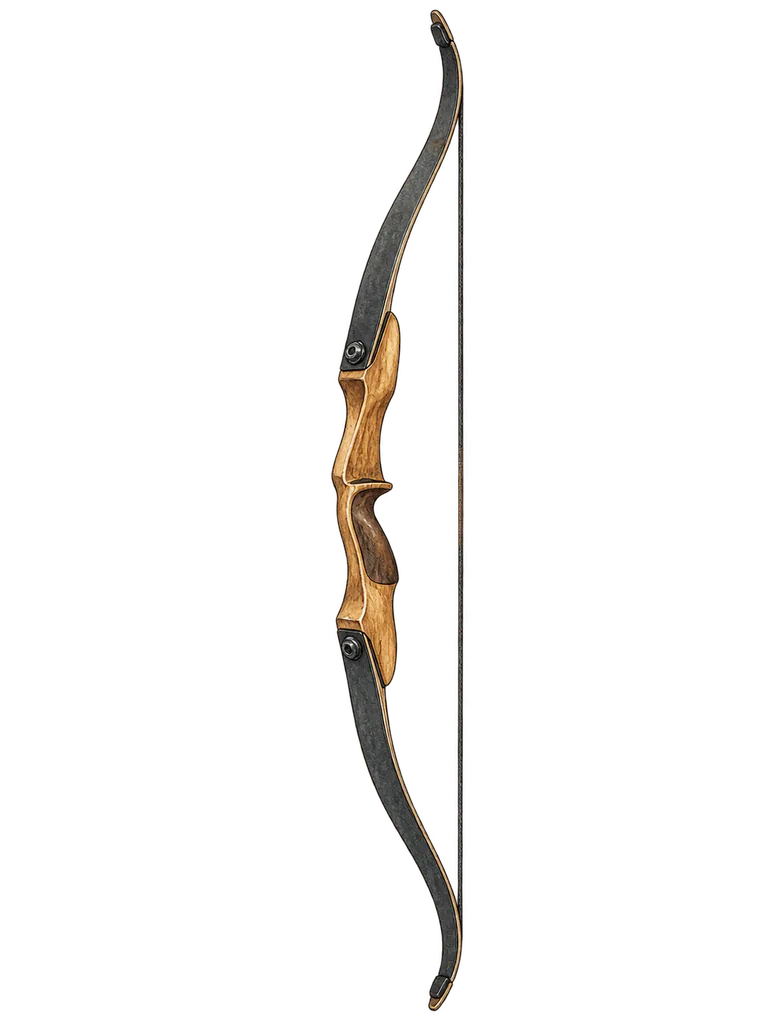
Not sure where to start? That’s the takedown most archers recommend first. The full roundup compares five beginner bows from maker specs.
First-bow mistakes I’d avoid
I made some of these myself: drawing short of my cheek, a sloppy stance, and a dry fire that had the whole range going “whoa.”
Buying the heaviest bow you can pull once
Buy a weight you can hold for 8 seconds, ten times in a row.
Sizing the bow by your height
Size it by your draw length, then go longer between sizes.
Buying a one-piece first
Start with a takedown and swap limbs as you get stronger.
Stringing it by hand or step-through
Use a limb-tip stringer, every single time.
Shooting arrows that don’t match
Match arrow spine to your real draw weight and length.
Letting someone dry-fire it
Never release a drawn string without an arrow. Walk away from used bows that were.
Your buying checklist
Everything above, in the order I’d do it.
- 1Find your dominant eyeThat decides right-hand or left-hand.
- 2Measure your draw lengthWingspan ÷ 2.5, then confirm at a shop.
- 3Pick the shapeRecurve for most beginners; longbow or horse bow if you know you want one.
- 4Choose takedownSo you can swap limbs as you get stronger.
- 5Set the weight25–30 lb at your draw length for most adults.
- 6Read the length chartBetween sizes, go longer.
- 7Budget for the restStringer, arrows, tab and arm guard on day one.
Questions I get about traditional bows
What’s the easiest traditional bow for a beginner?
A takedown recurve. It’s forgiving, it packs down small, and you can swap in heavier limbs as you get stronger instead of buying a new bow.
What size traditional bow do I need?
Measure your wingspan, divide by 2.5 to get your draw length, then read the bow length chart. A 28″ draw usually lands on a 66–68″ recurve or a 68–70″ longbow.
Can I hunt with a traditional bow?
Yes, where your state allows it. Washington requires at least 40 lb for big game. Build up to your hunting weight over a season and practice at the distances you’ll actually shoot.
Do I need a sight on a traditional bow?
No. Most traditional archers shoot instinctively or use gap shooting. Skip sights and stabilizers until your form holds for a month.
What draw weight should a beginner start with?
Most adults should start around 25–30 lb at their own draw length. Even experienced compound shooters do better starting near 30 lb on a traditional bow.
Is a longbow harder to shoot than a recurve?
A little. Longbows are slower and less forgiving of a sloppy release, but they’re quiet and smooth. Many people learn on a recurve and buy a longbow second.
One-piece or takedown for a first bow?
Takedown. You’ll outgrow your first draw weight, and new limbs cost far less than a new bow. Buy the one-piece later, once you know your weight.
How do I find my real draw weight?
Hook a bow scale on the string, draw to your anchor and read it. Or start from the marked weight and adjust about 2–3 lb per inch of draw above or below 28″.
Have a question I didn’t answer?
Or use the contact page →