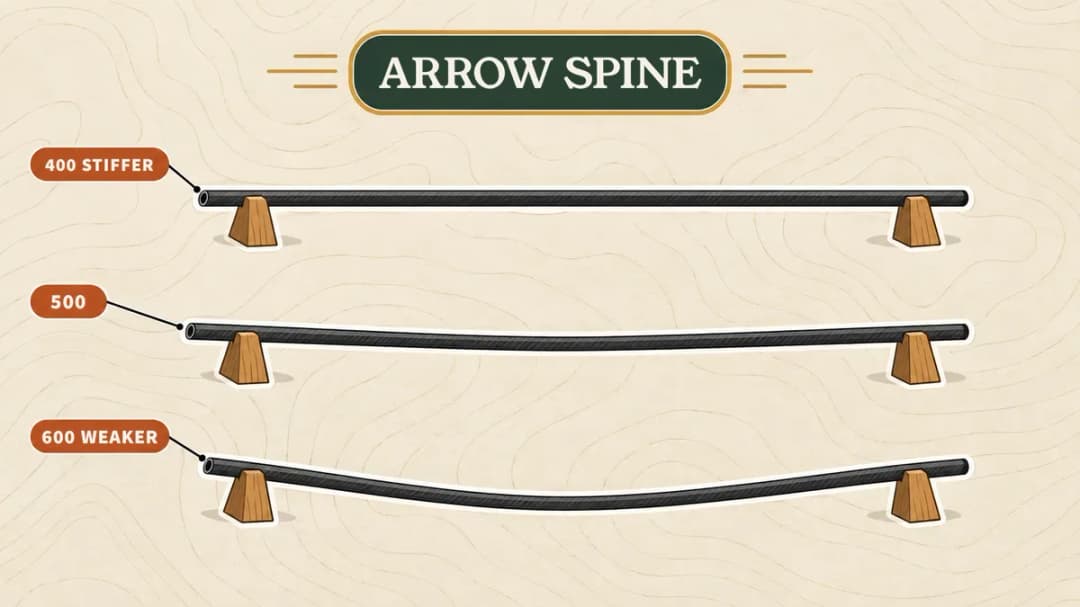


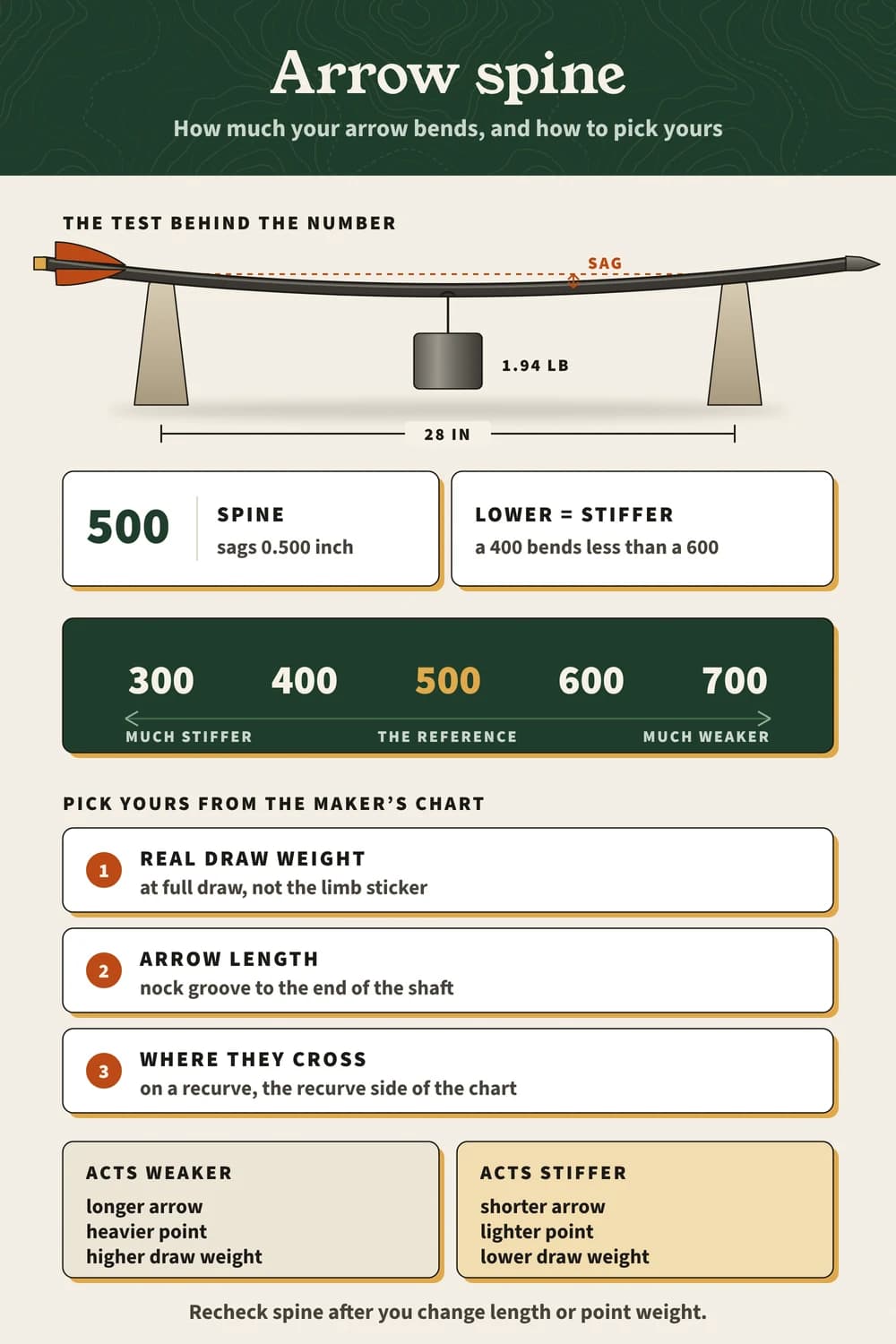
- Arrow spine is how much a shaft bends, and a lower number is stiffer: a 400 bends less than a 600.
- You need only two numbers: your real draw weight at full draw (not the limb sticker) and your arrow length, nock groove to shaft end.
- On a recurve, read the recurve side of the maker’s chart; compound columns give the wrong spine.
- Longer arrows and heavier points make an arrow act weaker, so recheck spine after either change.
400, 500, 600. Every arrow listing throws these at you like you should already know. 😵💫
Here’s the secret: spine is how much an arrow bends, and a lower number means a stiffer arrow. Match it to your real draw weight and arrow length on the maker’s chart, or start with the arrow spine finder. Get it right and your arrows fly straight, so your groups finally show what your form is doing.
How arrow spine works: why the bend has to match your bow
Arrow spine is the stiffness of an arrow shaft: how much it bends under a set weight. Every arrow flexes when the string drives it forward. So the question isn’t whether it bends but whether it bends the right amount for your bow.
The arrows that came with my first bow taught me this. After talking to some people at the range, I learned how bad they were and stopped shooting them.
The really bad thing about it was the terrible, terrible arrows that came with it. They were way too long for one thing and they're extremely flimsy, terrible spine.
A spine that doesn’t match your bow makes a clean release look bad, because the arrow leaves the bow still bending the wrong way and lands off to one side. That’s why spine comes before material or brand when you pick arrows (materials are covered in carbon vs aluminum arrows).
How to read spine numbers: the 28-inch test behind them
Spine numbers come from a standard bench test, ASTM F2031. The shaft rests on two supports 28 inches apart, a 1.94 lb (880 g) weight hangs from the middle, and the sag is measured in thousandths of an inch.
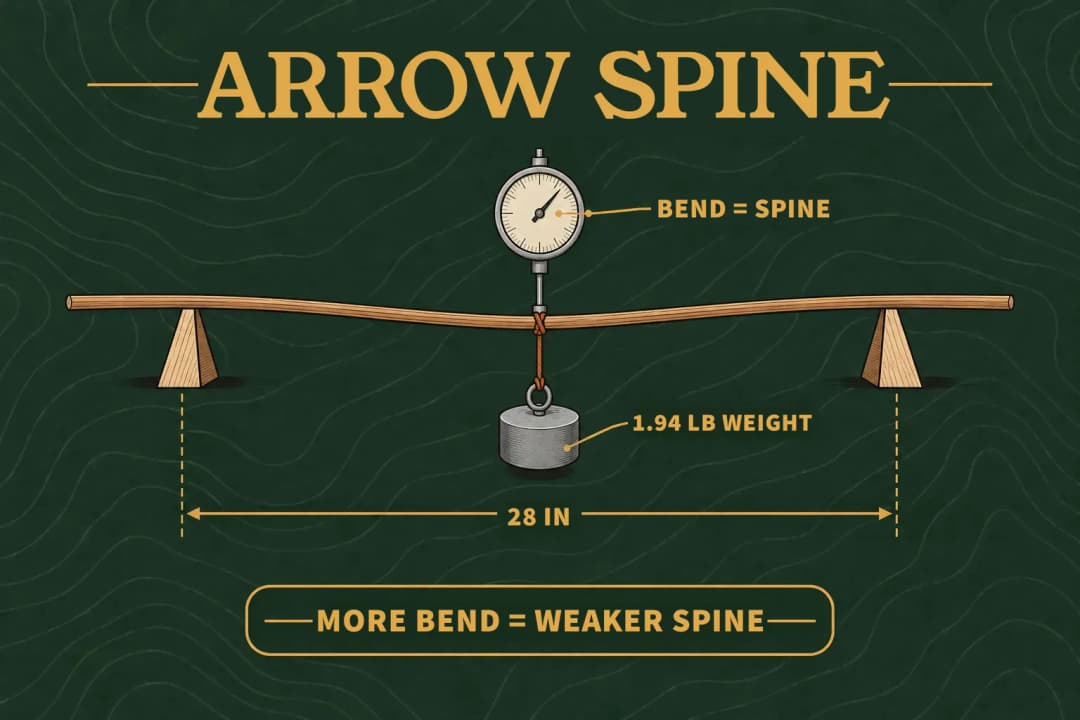
So a 500-spine arrow sags 0.500 inch, and a lower number means a stiffer shaft. A 300 is much stiffer than a 700, which is the opposite of what most beginners guess.
| Spine number | Sag in the test | Compared with a 500 |
|---|---|---|
| 300 | 0.300 in | Much stiffer |
| 400 | 0.400 in | Stiffer |
| 500 | 0.500 in | The reference |
| 600 | 0.600 in | Weaker |
| 700 | 0.700 in | Much weaker |
How to pick your arrow spine from a chart in 3 steps
Every arrow maker publishes a spine chart for its shafts, often with separate tables for recurves and compounds. A chart is a starting point, not a final answer, but it gets you close on the first try.
Two-time Olympic silver medalist Jake Kaminski, in his spine selection video, says the inputs are simpler than most beginners fear:
How long your arrow is and how many pounds you’re shooting at full draw is really all you need to know. That’s it.
I agree, and the catch is the word “full draw”: he points out that his own 42 lb limbs pull anywhere from 42 to 48 lb depending on how he sets the limb bolts, so the sticker alone can put you a whole spine size off.
- Find your real draw weight. Use the peak weight you actually pull at your own draw length; the number printed on the limbs is measured at a standard draw length, so yours can be higher or lower (the draw weight calculator helps).
- Measure your arrow length from the groove of the nock to the end of the shaft, not to the point. It follows from your draw length (start with the draw length calculator), and longer arrows act weaker.
- Find where they cross. On the maker’s chart for your bow type, go across from your draw weight and down from your arrow length: the box where they meet is your spine for the chart’s standard point weight.
Kaminski explains why the arrow is measured that way:
It’s from the groove of the nock to the end of the shaft. It is not to the end of the point. That is because the point does not flex when the arrow is flexing.
That’s an easy one to get wrong at home with a tape measure. Measure the shaft, not the whole arrow, or you’ll read the chart one column long and pick an arrow that’s too stiff.
On a recurve, also make sure you’re reading the right half of the chart. Kaminski is blunt about it:
If it doesn’t have recurve listed, do not use that arrow chart. I would suggest using another manufacturer that does have a recurve suggestion, because recurve bows need different spine arrows than compound bows.
He blames this on shops more than archers, since most US shops are compound shops. If a shop picks your recurve arrows, ask which side of the chart they read; it takes a second and can save you a dozen wrong arrows.
If you’d rather skip the chart, the arrow spine finder does the same lookup. Then shoot a few and watch how they fly, because every bow and every release is a little different.
What makes an arrow act stiffer or weaker on your bow
The number on the shaft is its static spine, measured on the bench. How the arrow behaves when you shoot it, its dynamic spine, also depends on what’s attached to it and how hard it’s pushed.
| What changes | The arrow acts | What it means for you |
|---|---|---|
| Longer arrow | Weaker | Cutting too long a shaft? Expect a weaker spine than the label. |
| Shorter arrow | Stiffer | Cutting arrows shorter stiffens them. |
| Heavier point | Weaker | Moving to heavier points can need a stiffer shaft. |
| Lighter point | Stiffer | A quick fix for an arrow that acts a little weak. |
| Higher draw weight | Weaker | Stronger bows need lower spine numbers. |
| Lower draw weight | Stiffer | Lighter bows suit higher spine numbers. |
That’s why one shaft can be right for one archer and wrong for another. A friend’s arrows may fly perfectly from their bow and badly from yours.
Signs your arrow spine is wrong, and how a bare shaft shows it
Shot with fingers, an arrow flexes sideways around the riser as it leaves, part of what’s called the archer’s paradox. A matched arrow recovers quickly and flies straight; a mismatched one keeps fishtailing and drifts to one side.
The classic check is bare-shaft tuning: shoot a few fletched arrows and one or two without fletching from about 10 yards, then compare where they land. For a right-handed shooter:
- Bare shaft lands left of the fletched group: the spine is too stiff.
- Bare shaft lands right: the spine is too weak.
- Bare shaft lands high or low: that’s your nocking point, not spine, so fix it first.
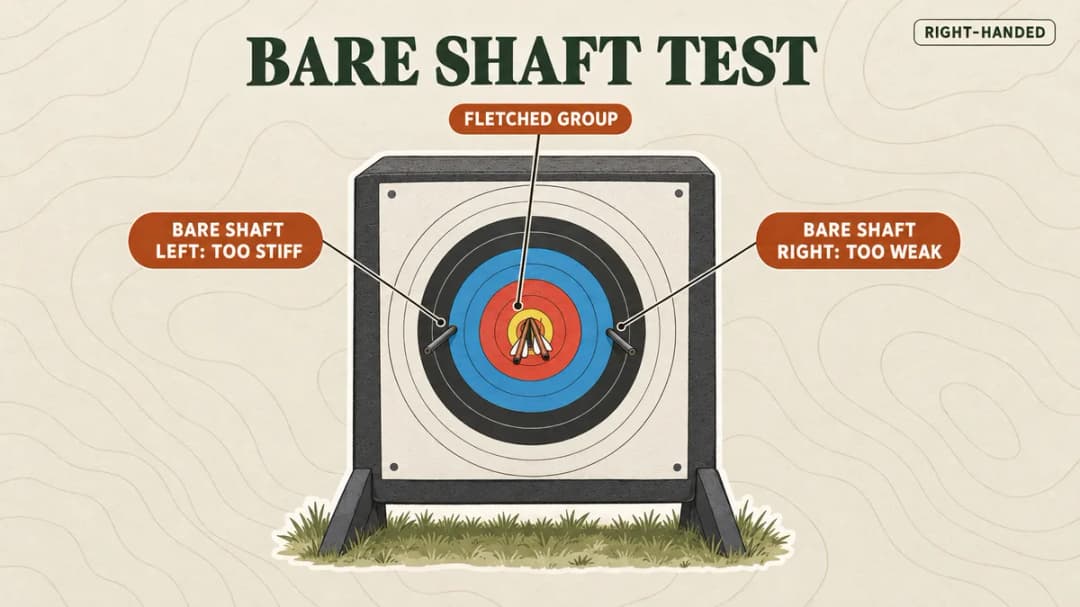
Left-handed shooters read it the other way round. To weaken a stiff arrow, add point weight or go to a weaker spine; to stiffen a weak one, use a lighter point or a stiffer shaft.
Compound shooters using a release aid see the arrow flex up and down rather then side to side. The spine still has to match the bow so use the compound table on the maker’s chart.
// Free printable
Get the range log I actually use.
Seventeen printable pages: session log, score tracker, a 30-day drill challenge, a bow maintenance card, a first-season checklist and more. Join the monthly email and it lands right away.
Wood arrows: spine in pounds instead of numbers
Traditional wood shafts are usually sold by a bow-weight range instead of a deflection number, like 45–50 lb. The label means the shaft suits a bow of roughly that draw weight, and wood is commonly sorted in 5 lb steps.
The same rules still apply: longer shafts and heavier points act weaker. If you shoot a longbow or a traditional recurve, check the arrow maker’s wood chart for your draw weight and arrow length.
Here’s spine on one page: what the number means and how to pick yours.
// FAQ
Frequently asked questions
Quick answers to the questions readers ask most.
What does a 500 spine arrow mean?
It sags 0.500 inch when a 1.94 lb weight hangs from the middle of a 28-inch span. Lower numbers are stiffer, higher numbers are weaker.
Is a higher spine number stiffer or weaker?
Weaker. A 700 bends more than a 400, so stronger bows need lower spine numbers.
Does draw weight change the spine I need?
Yes. The more weight pushing the arrow, the stiffer (lower-numbered) the shaft you need, which is why every spine chart starts with your peak draw weight.
Does point weight change arrow spine?
It changes how the arrow acts. Heavier points make it act weaker and lighter points make it act stiffer, so recheck how your arrows fly after you swap points.
Do crossbow bolts have a spine?
Bolts are stiff shafts too, but crossbow makers usually specify the bolt length, minimum weight and nock type instead of a spine. Follow your crossbow’s manual.
Final thoughts
Spine sounds technical, but it comes down to one idea: the arrow has to bend the right amount for your bow. Find your real draw weight and arrow length, read the maker’s chart, then let a bare shaft tell you how close you got.
Once your arrows match your bow, your misses start telling you about your form instead of your gear. Log your groups in the free range log as you go, and you’ll see the difference within a few sessions.
