
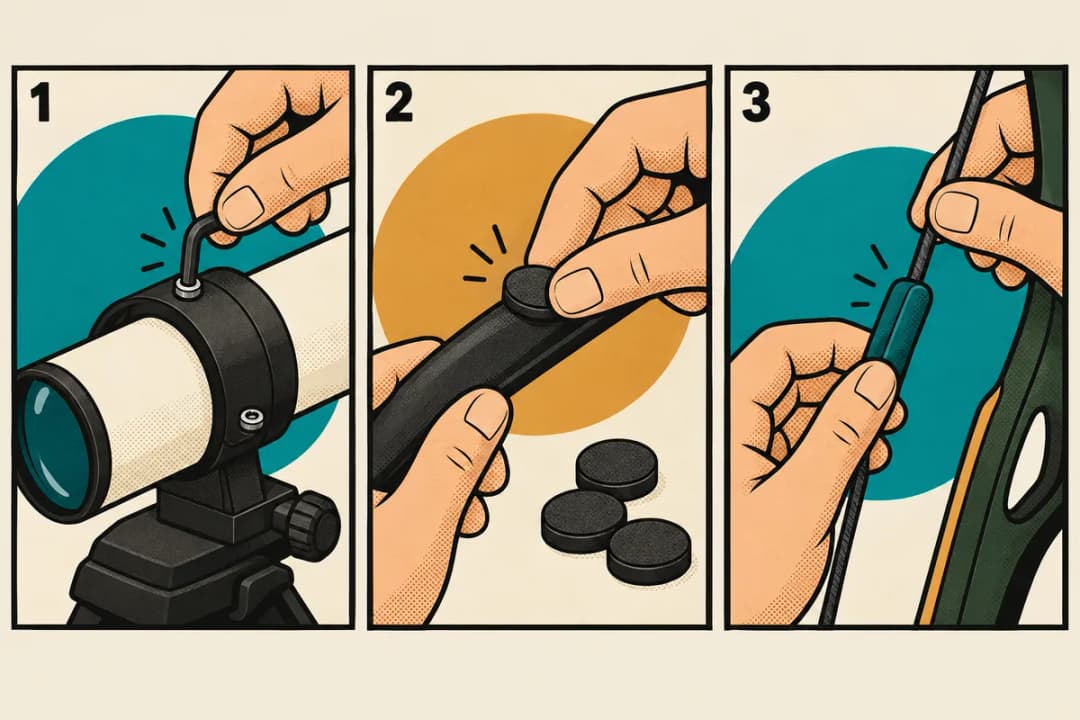


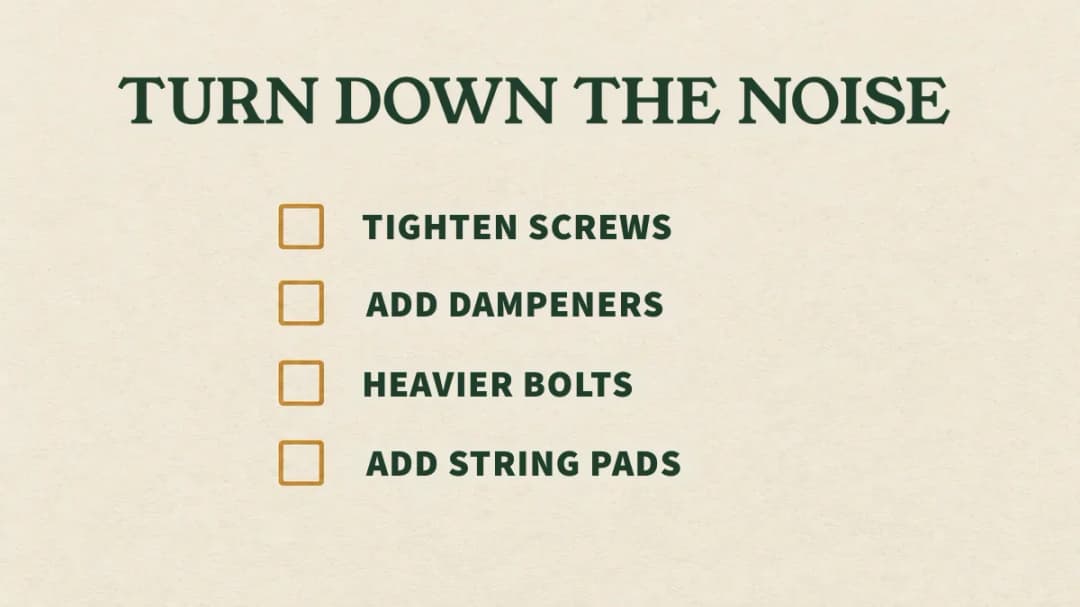
- Tighten every fastener first: loose screws rattle and hum at the shot.
- String stops, limb dampeners and string leeches soak up the vibration that becomes noise.
- Heavier bolts run quieter: one test measured 91.1 dB with a 682-grain bolt vs 95.1 dB with a 451-grain bolt.
- Practice silent safety and cocking habits, because handling noise spooks deer too.
A deer steps into range, you squeeze the trigger, and the crack of your crossbow makes it jump the string before the bolt arrives. 😩
The good news is the fix is mostly cheap: tighten everything, add string stops and dampeners, shoot a heavier bolt and handle the bow quietly. Ten small jobs before the season, and your next shot lands before the deer can react.
Why crossbows are loud, and what you can quiet
A crossbow’s noise is leftover energy. Whatever energy doesn’t go into the bolt turns into vibration in the limbs, string, cables and stock, and vibration is sound.
Chris Larson of CrossbowExpert.com, whose video closes this post, sums it up in three words:
Basically, the sound that you’re hearing is energy leaving the crossbow. Energy equals sound as it’s dissipating from the crossbow when you pull the trigger.
Energy equals sound is the idea to keep in your head while you read the ten tips. Each one either sends more energy into the bolt or catches what’s left before it reaches the air.
So every tip below does one of two things: it puts more energy into the bolt, or it absorbs the rest before it becomes noise.
| Tip | What it quiets | Effort |
|---|---|---|
| 1. Tighten fasteners | Rattles and buzz | Low |
| 2. Rubber dampeners | Limb and stirrup vibration | Low |
| 3. String stops | String slap after the shot | Medium |
| 4. String suppressors | String oscillation | Medium |
| 5. Heavier bolts | Overall shot noise | Medium (re-sight) |
| 6. Heavier points | Overall shot noise | Medium (re-sight) |
| 7. Silent safety habits | Handling clicks | Practice only |
| 8. Dampening wraps | Stock and rail hum | Low |
| 9. String wax | Fuzzy, dry string | Low |
| 10. Cable silencers | Cable slap | Low |

// Free printable
Get the range log I actually use.
Seventeen printable pages: session log, score tracker, a 30-day drill challenge, a bow maintenance card, a first-season checklist and more. Join the monthly email and it lands right away.
Quiet the hardware: tighten, dampen and stop the string (tips 1–4)
Start with the bow itself. These four fixes deal with noise at its source.
1. Tighten all fasteners
Loose screw’s vibrate at the shot, and the scope mount is a common culprit. Check every screw from the limb pockets to the scope rings before each season; a solid crossbow is quieter and more accurate.
A rock-solid mount matters even more if you upgrade your optics, see the best crossbow scopes.
2. Add rubber dampeners
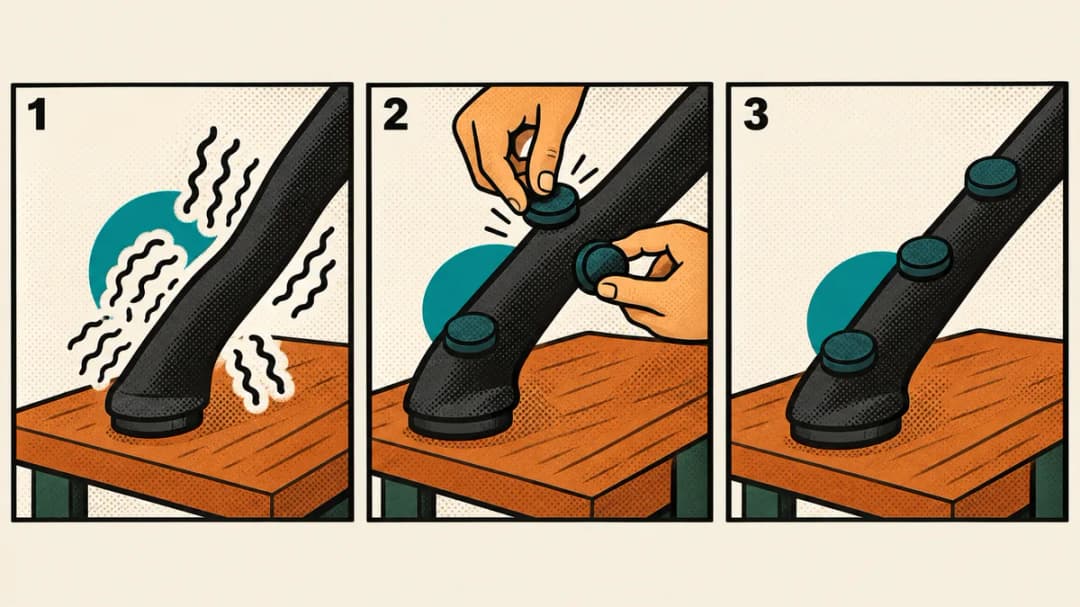
Rubber or polymer dampeners absorb vibration before it becomes sound. And crossbow kits from brands like LimbSaver include limb dampeners and stirrup dampeners, and they go on in minutes.
Spread them out rather than stacking them in one spot. The more places the vibration is caught, the less reaches the air.
3. Install string stops
String stops catch the string at the end of the shot so it doesn’t slap and buzz. Many crossbows ship with them from the factory.
If your crossbow has none, check whether the maker offers a kit that fits your model. Generic stops that don’t fit can touch the string and hurt accuracy.
4. Add string suppressors
String suppressors sit near where the string comes to rest and soften its recoil. Excalibur’s R.E.D.S. suppressors are one example: pads that absorb the string’s follow-through, sold by model series and built into some Excalibur packages.
They pair well with string stops. Together they deal with both the slap and the wobble after the bolt leaves.
Quiet the shot with your bolts and points (tips 5–6)
This is the biggest single change you can make. A heavier bolt takes more energy, so less is left over as noise.
5. Use heavier bolts
In a Grand View Outdoors test, a TenPoint Nitro XRT measured 95.1 dB with a 451-grain bolt and 91.1 dB with a 682-grain bolt. The heavier bolt hit about 2 inches lower at 30 yards.
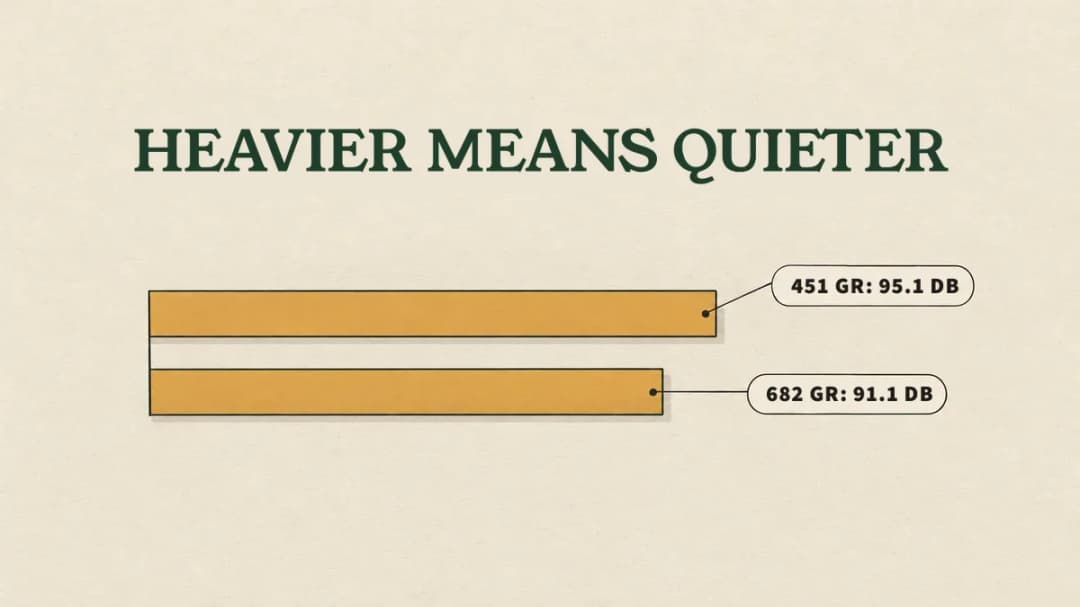
The readings came from a smartphone app, so treat them as rough. A 4 dB drop is real but modest: about 2.5 times less sound energy, not silence.
The trade-off is less speed and more drop at long range. Stay within the bolt weights in your manual; my best bolts guide explains how to choose.
Larson gives the clearest proof that the bolt soaks up the noise: listen to a shot with no bolt at all.
If you’ve ever been around when someone dry fires a crossbow, you’ll notice that it is super loud, way louder than just a normal crossbow shot, and that’s because the arrow didn’t absorb any of that energy.
I’ve heard that sound from my own recurve, and it’s not one you forget. Treat it as the reason heavier bolts work, never as a test: a dry fire can wreck a crossbow, and so can a bolt under your manual’s minimum.
6. Switch to heavier points or broadheads
A heavier field point or broadhead raises the total bolt weight and moves the balance forward. It works on the same principle as tip 5, just on a smaller scale.
Re-sight your scope whenever you change point weight, because the bolt will hit lower. Need new heads? See the best broadheads.
Quiet your handling: safety, cocking and movement (tip 7)
A quiet bow won’t help if your hands are loud. Most handling noise happens before the shot.
7. Practice silent safety engagement
The click of a safety can be enough to make a deer look up. Practice moving the safety slowly, with a thumb covering it, until it’s second nature.
Larson calls this his favorite tip because it costs nothing, and he’s specific about where the habit gets built:
When you’re on the range and you’re shooting your crossbow, what I would do is practice moving that safety quietly, so when you are hunting you’re already used to it.
He’s right that you can’t switch this on for opening day. Whatever you do a hundred times at the range is what your hands do when a buck steps out, so make the quiet version the only version you practice.
Cock the crossbow on the ground at the base of your stand, too, since cocking is loud and takes a lot of movement. Hunter-education courses say to haul it up unloaded, with the line tied away from the trigger, and load only once you’re settled.
Quiet the string and cables: wraps, wax and silencers (tips 8–10)
The last three are small, cheap and easy. They clean up the noise the bigger fixes leave behind.
8. Add sound-dampening wraps
Self-adhesive dampening wraps or tape on the stock, rail sides and riser can cut hum and the click of bolts or gear touching metal. Keep them clear of the rail’s flight path and the string.
9. Wax the string
String wax is maintenance first: it keeps strands from drying out and fraying. A well-waxed string also stays tight and smooth, so it’s less likely to fuzz and buzz.
Wax it as often as your manual says, and never wax the center serving where the latch grabs the string.
No wax in the box? Use the one your manual names, or a wax made for synthetic bowstrings such as Bohning’s Tex-Tite:

Tex-Tite Wax
Bohning 1306 Tex-Tite Bowstring Wax 1oz, Clear
by Bohning
Affiliate link: I may earn a commission, at no cost to you.
Key features
- String wax made for synthetic bowstrings
- Keeps fibers from drying and fraying, so the string lasts longer
- Stays tacky in heat and cold, so it works year round
- Small 1 oz tube that fits in a quiver pocket
Specs
- Brand
- Bohning
- Model
- 1306
- Size
- 1 Ounce (Pack of 1)
- Color
- Clear
- Length
- 9.8 Inches
- Weight
- 0.05 Pounds
10. Add cable silencers or string leeches
On a compound crossbow, cable silencers and string leeches soften the slap of the cables and string after the shot. They’re cheap and quick to install.
Keep them away from the cams and the rail. Anything that touches a moving part can slow the bolt or throw off accuracy.
More crossbow quieting tips and common mistakes
Hardware is only half of it. These habits keep a quiet crossbow quiet:
- Use a solid rest so the crossbow doesn’t rattle against the blind window.
- Keep up regular inspections, not just a once-a-year tighten.
- Pad your quiver and bolt holder so bolts don’t click together.
- Listen to your crossbow at the range and fix new noises right away.
| Do | Don’t |
|---|---|
| Check for loose parts before every season | Over-tighten and strip screws |
| Use bolts within your manual’s weight range | Shoot bolts lighter than the minimum |
| Wax and inspect the string on schedule | Let dampeners touch the string or cams |
| Practice quiet handling at the range | Wait until opening day to fix noise |
Pros and cons of quieting a crossbow
A quieter crossbow helps, but it isn’t free. Here’s the trade-off.
Pros
- Less chance a deer reacts before the bolt arrives
- Fewer spooked animals for your next shot
- Tightening and inspecting often catches problems early
Cons
- Heavier bolts fly slower and drop more at long range
- Add-ons can touch moving parts if installed badly
- It takes time to test and re-sight after changes
If you’re still choosing a crossbow, a quieter model gives you a head start; see my guide to the best crossbows. Practice your quiet routine on one of the best crossbow targets.
If you learn by watching, this video shows how to make your crossbow quieter.
// FAQ
Frequently asked questions
Quick answers to the questions readers ask most.
Why is my crossbow so loud?
Most noise is leftover energy turning into vibration, plus loose parts rattling. Tighten everything first, then add dampeners and string stops.
Do heavier bolts make a crossbow quieter?
Yes. One test measured 91.1 dB with a 682-grain bolt vs 95.1 dB with a 451-grain bolt from the same crossbow.
Does string wax make a crossbow quieter?
A little, mostly by keeping the string smooth and in good shape. Its main job is protecting the string.
Can a crossbow be too quiet?
No, but add-ons can go too far if they touch the string, cables or cams. Anything that slows the string costs speed and accuracy.
Is there an optimal bolt weight for reducing noise?
Heavier is quieter, within the range your manual allows. Most hunters land on a standard or heavy bolt and re-sight their scope for it.

Final thoughts
A quieter crossbow is mostly about catching leftover energy. Tighten, dampen, go a little heavier on the bolt, and handle the bow quietly, and you take away most of the deer’s warning.
Make one change at a time and check your groups after each. The free range log is a handy place to track what you changed and how it shot.
