


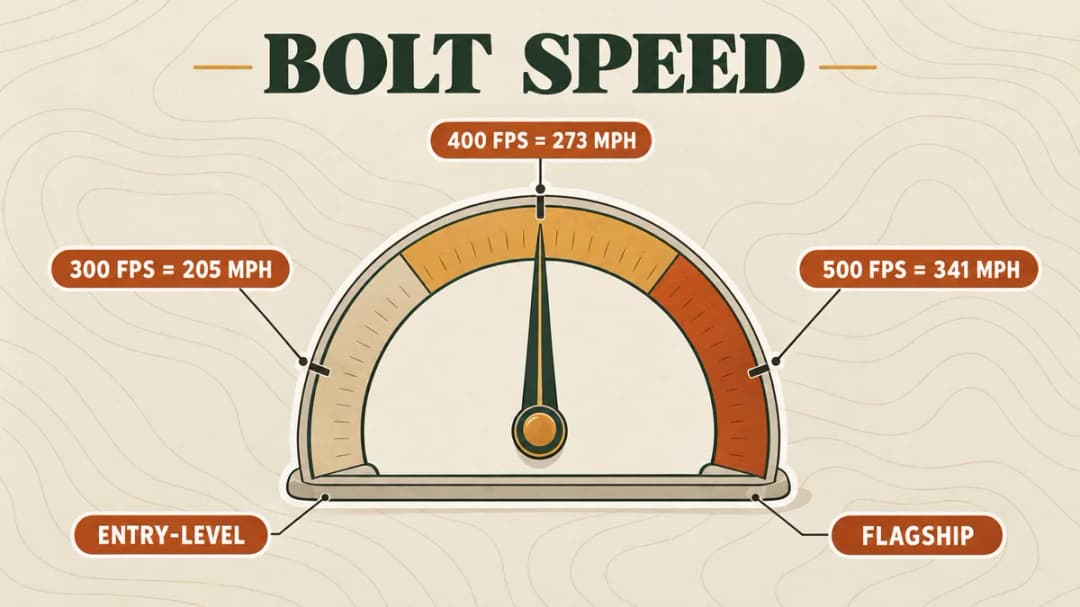
- A modern crossbow bolt leaves the rail at about 300–500 fps, or roughly 205–340 mph.
- Speed comes from power stroke, draw weight and bolt weight; heavier bolts fly slower.
- Don’t pay for speed past about 350 fps: above that, extra speed buys a flatter path, not a cleaner kill.
- Hunting laws regulate draw weight and seasons, not bolt speed, so check your state agency.
Here’s a number to calm you down: most crossbow bolts fly between about 300 and 500 feet per second (205 to 340 mph). 😌
Anything in that range carries more than enough energy for deer, so the bigger number on the next box is mostly marketing. Buy for accuracy and fit, and let the basics of crossbow ballistics show you where that speed counts.
How fast is a crossbow bolt? Speeds in fps and mph
Crossbow speeds are measured in feet per second (fps) as the bolt leaves the rail. Entry-level hunting crossbows sit around 300–350 fps; flagship models reach about 500–515 fps.
The fastest production crossbows are rated 500–515 fps: the Ravin R500 at 500 and the TenPoint TRX Ultra at 515. Speed has climbed fast: TenPoint’s Nitro XRT was already rated 470 fps in 2019.
| Speed (fps) | Speed (mph) | Energy with a 400-grain bolt | Example |
|---|---|---|---|
| 300 fps | 205 mph | 80 ft-lb | Entry-level hunting crossbow |
| 350 fps | 239 mph | 109 ft-lb | Common budget-to-mid range |
| 400 fps | 273 mph | 142 ft-lb | Wicked Ridge RDX 400 (rated 400 fps) |
| 410 fps | 280 mph | 149 ft-lb | TenPoint Siege RS410 (rated 410 fps) |
| 500 fps | 341 mph | 222 ft-lb | Ravin R500 (rated 500 fps) |
| 515 fps | 351 mph | 236 ft-lb | TenPoint TRX Ultra (rated 515 fps) |

// Free printable
Get the range log I actually use.
Seventeen printable pages: session log, score tracker, a 30-day drill challenge, a bow maintenance card, a first-season checklist and more. Join the monthly email and it lands right away.
What determines crossbow bolt speed: 3 factors you control
Three things set how fast your bolt flies. Two are built into the bow, and one is your choice every time you buy bolts.
Power stroke and draw weight
The power stroke is how far the string travels from cocked to rest, and the draw weight is the force needed to cock it. A longer stroke or a heavier draw stores more energy, which means more speed. Read more in crossbow ballistics and mechanics.
Bolt weight
Bolt weight is measured in grains (usually counting the 100-grain tip). A lighter bolt flies faster; a heavier one flies slower but carries a bit more energy. Pick bolts that match your crossbow.
Bolt design and fletching
Straight, consistant bolts with matched vanes fly more predictably. Consistency from bolt to bolt matters more than a few extra fps.
| Factor | Effect on speed | What to do |
|---|---|---|
| Power stroke | Longer stroke = faster | Compare stroke length, not just fps |
| Draw weight | Heavier draw = faster | Use a cocking aid for heavy bows |
| Bolt weight | Lighter bolt = faster | Stay at or above the maker’s minimum |
How bolt speed affects crossbow hunting: energy, drop and noise
Speed changes four things in the field and less drop is the only one that really helps you: even 300 fps carries plenty of energy.
- Energy: deer need about 25–41 ft-lb by Easton’s chart, and even 300 fps with a 400-grain bolt gives about 80.
- Drop: a faster bolt drops less, so a small range mistake costs you less.
- Noise: fast, high-energy bows are often loud, and a deer can react to the sound.
- Wear: more stored energy means more stress on strings, cables and limbs.
Outdoor Life put the two fastest crossbows on a Doppler chronograph in the video below. Watch for the 50-yard speed: it shows how little a fast bolt slows down over a hunting distance.
Scott Einsmann, Outdoor Life’s gear editor, puts the energy side of this in one comparison. Both crossbows in his test shoot 400-grain bolts:
At 50 yards when it’s hitting that target, it has more kinetic energy and momentum than a compound bow shooting 300 feet per second with a 600 grain arrow at point blank.
That’s a striking number, and it backs up my point above. A deer needs a fraction of that energy, so past a certain speed the extra fps buys you nothing on the energy side.
Where speed does pay is the drop, and his test shows how little a 500 fps bolt falls:
I shot both of these crossbows at 20 and then at 40 yards using the same aiming point, and the bolts only dropped an inch, inch and a half.
That’s the real benefit of speed: a range mistake costs you less. A slower crossbow drops more between those distances, so range your shots and practice at the distances you’ll hunt.
To choose a crossbow on more than its speed, see my best crossbows.
Crossbow bolt speed laws: what regulations actually limit
US hunting rules don’t usually set a bolt speed. They set seasons, broadhead rules and, in some states, a minimum crossbow draw weight.
UK crossbow law
Crossbows are legal for adults in the UK, but the Crossbows Act 1987 makes it an offence to sell one to anyone under 18. Hunting with a crossbow is illegal in the UK: the Wildlife and Countryside Act 1981 bans using a bow or crossbow to kill or take wild animals and birds. Read more about whether crossbows are legal in the UK.
Gear that helps you use your bolt speed
You can’t add much speed with accessories, but you can make the speed you have useful. Match your gear to your real fps.
Speed-adjustable scopes
Many crossbow scopes have a speed dial that lines the aiming points up with your bow’s fps. Set it to your measured speed, not the box number. See the best crossbow scopes.
Broadheads
Broadheads don’t add speed, but a poorly matched head can fly differently from your field points. Check that your broadheads hit with your field tips before the season. Start with the best broadheads.
Crossbow practice tips for faster, more accurate shots
A well-placed bolt at 350 fps beats a wild one at 500. These habits matter more than the number on the box.
- Practice regularly from the positions you’ll hunt in.
- Keep your crossbow tuned: waxed string, lubed rail, tight screws.
- Shoot the right bolts: the length and weight in your manual.
- Know your limits: don’t take shots past your practiced range.
- Use a rangefinder so you pick the right aiming point.
Faster crossbow bolts: pros and cons
Speed is a trade-off. Here’s what you gain and what you give up.
Pros
- Flatter path and less drop at longer ranges
- Less time for the animal to move before impact
- More energy with the same bolt
Cons
- Often louder at the shot
- More wear on strings, cables and limbs
- Fast bows usually cost more and need heavier draw or a crank
// FAQ
Frequently asked questions
Quick answers to the questions readers ask most.
How fast is a crossbow bolt in mph?
A bolt at 300 fps travels about 205 mph, and one at 400 fps about 273 mph. The fastest crossbows, at 500–515 fps, reach about 340–350 mph.
Is 400 fps fast for a crossbow?
Yes. 400 fps is fast for a hunting crossbow and far more than you need for deer; only flagship models go much past it.
What is the fastest crossbow?
The TenPoint TRX Ultra (rated 515 fps with a 410-grain arrow) and the Ravin R500 (rated 500 fps) are among the fastest production crossbows. Outdoor Life’s test clocked TenPoint’s earlier Nitro 505 at 515 fps and the R500 at 502 fps with 400-grain bolts.
Does a heavier bolt slow a crossbow down?
Yes. A heavier bolt leaves the rail slower, but it usually carries a little more energy and can penetrate better.
Do crossbow bolts slow down over distance?
Yes, every bolt loses speed and drops after it leaves the rail. That’s why crossbow scopes have separate aiming points for 20, 30 and 40 yards and beyond.

Final thoughts
A crossbow bolt flies somewhere between 300 and 500 fps, and any speed in that range is plenty for deer. What wins the shot is a bolt that matches your bow, a scope set to your real speed and practice at your hunting distances.
Track your groups at each distance in the free range log. You’ll see exactly where your bolts land.
