

- Power stroke and draw weight set how fast a crossbow can push a bolt.
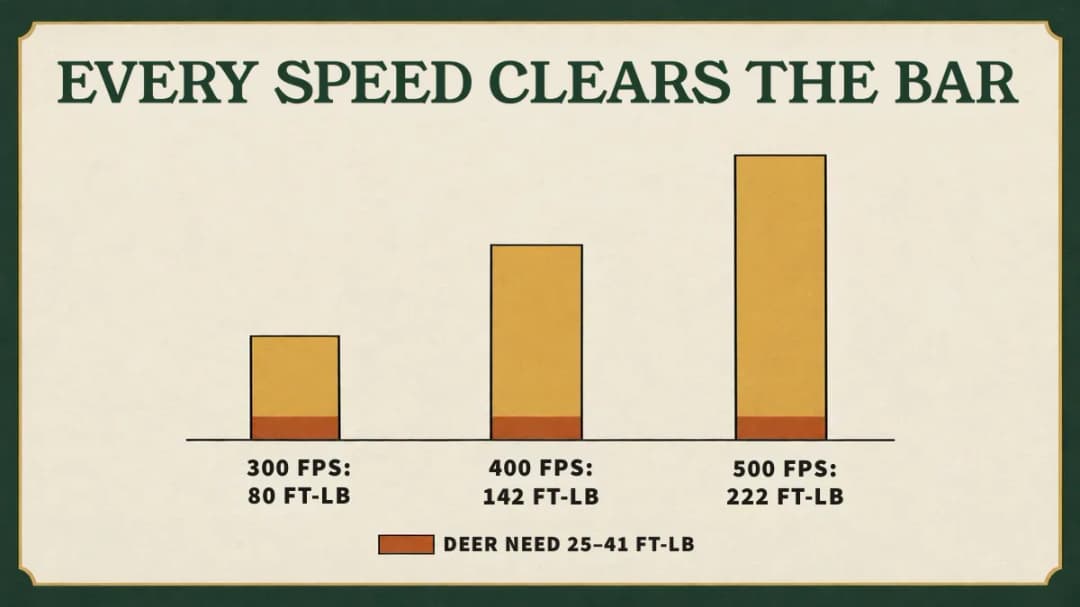
- Kinetic energy comes from bolt weight and speed together: a 400-grain bolt at 400 fps carries about 142 ft-lb.
- Consistent speed matters more than top speed, because your scope’s aiming points assume it.
- The rail, trigger and scope decide whether that energy lands where you aimed.
400 fps on the box. Impressive, and almost beside the point. 😏
Speed times bolt weight gives you energy, and a modern crossbow has plenty, so what decides a clean shot on a deer is consistency, a clean rail and a scope matched to your speed. Learn the parts below and check your bolt weight for hunting.
How a crossbow turns draw weight into bolt speed
A crossbow stores energy when you cock it and hands it to the bolt when the string is released. Two numbers control how much it can store: draw weight and power stroke.
Draw weight: the force it takes to pull the string back to the latch, often 150 lb or more on a hunting crossbow. A cocking aid or crank cuts the effort you actually feel.
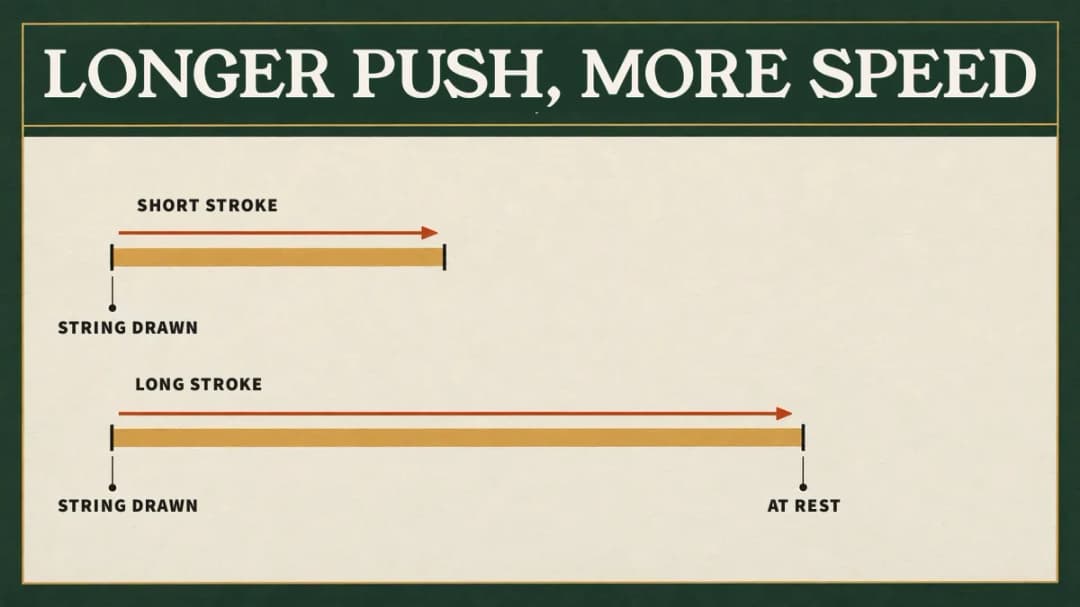
Power stroke: how far the string travels from the cocked position to rest. A longer stroke pushes the bolt for longer, which is why reverse-draw crossbows like the TenPoint Siege RS410 (13.5″ stroke) make high speed in a short body.

// Free printable
Get the range log I actually use.
Seventeen printable pages: session log, score tracker, a 30-day drill challenge, a bow maintenance card, a first-season checklist and more. Join the monthly email and it lands right away.
Bolt velocity: why consistent speed beats top speed
Most hunting crossbows today are rated between about 300 and 500 fps; flagships like the TenPoint TRX Ultra (515 fps) and Ravin R500 (500 fps) sit at the top of that range. Higher speed flattens the path of the bolt, so small range mistakes cost you less.
But the bigger win is consistency. Your scope’s aiming points assume the same speed every shot, so cock the bow the same way each time and shoot bolts of the same weight.
Kinetic energy: how much your crossbow bolt needs for deer
Kinetic energy (KE) is the work a bolt can do when it hits. The standard archery formula is KE (ft-lb) = bolt weight in grains × speed² ÷ 450,240.

| Bolt speed | 400-grain bolt | 450-grain bolt |
|---|---|---|
| 300 fps | 80 ft-lb | 90 ft-lb |
| 350 fps | 109 ft-lb | 122 ft-lb |
| 400 fps | 142 ft-lb | 160 ft-lb |
| 450 fps | 180 ft-lb | 202 ft-lb |
| 500 fps | 222 ft-lb | 250 ft-lb |
Easton’s widely used chart puts deer and antelope at 25–41 ft-lb and elk or black bear at 42–65 ft-lb. Even an entry-level crossbow clears that, so shot placement and a sharp broadhead matter far more than chasing more energy.
Brian Zabitsky of TenPoint puts the speed side of this in two sentences, in the maker’s tech tip on bolt weight:
Generally speaking, your crossbow applies a consistent amount of force each time you shoot it. Increasing or decreasing your arrow weight then increases or decreases the speed at which the arrow travels.
Thats the rule to carry into any spec sheet. An fps number means nothing without the bolt weight next to it, so compare two crossbows only at the same grains. And not all the stored energy reaches the bolt, either: the rest becomes vibration and noise, which is why heavier bolts usually shoot quieter.
Trajectory and drop: why your crossbow scope has several aiming points
From the moment it leaves the rail a bolt is falling and slowing down. The farther the target, the more it drops, which is why crossbow scopes use stacked crosshairs or dots for 20, 30, 40 yards and beyond.
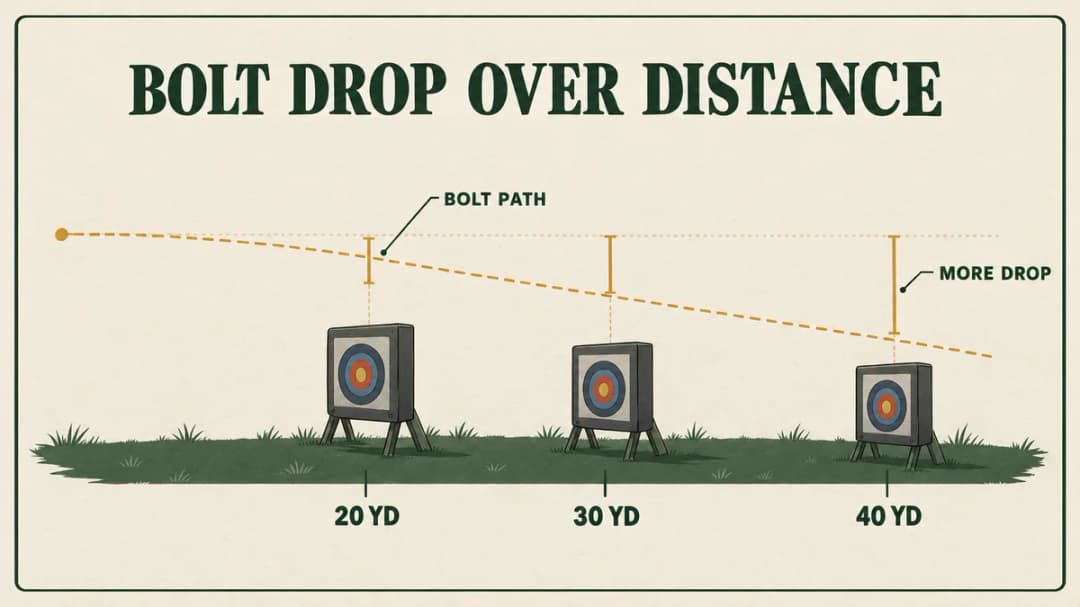
Your scope handles the drop once it’s sighted in and set for your bolt speed. Your job is the distance: know your exact range (a rangefinder helps) and pick the right aiming point.
Here’s what that looks like on a real hunt. A hunter on Yamaha Whitetail Diaries, the show in the video further down this post, passed on a deer because of the drop:
I ranged the actual animal at 53.4 yards. If he would have been three or four or five yards closer, I know that doesn’t seem like much, but that arrow is starting to fall a lot at that range.
That’s the right call. A few yards near the edge of your range change the drop more than a few yards up close, so a shot you’ve never practiced isn’t a shot to take.
Rail and flight groove: where a straight shot starts
The bolt rides on the rail (also called the barrel or flight deck), with one vane down in the flight groove. The odd-colored vane goes down in the groove so the fletching clears the rail.
The string slides along that rail every shot, so it needs care. Lube the rail as often as your owner’s manual says, or the string serving wears early.
Trigger mechanism and safeties: control at the moment of release
A good trigger breaks cleanly with no surprise, so it doesn’t pull your aim. Many hunting crossbows use a two-stage trigger; the Siege RS410’s breaks at 3.5 lb.
Most modern crossbows also have an automatic safety and an anti-dry-fire device that blocks a shot with no bolt seated. Treat those as backups, not permission to relax.
Scope alignment: sight in for your bolt speed
A scope that’s off by a little at 20 yards is off by a lot at 40. Sight in with the exact bolts and tips you’ll hunt with.
- Shoot a group up close to get on paper.
- Set the top aiming point at 20 yards, the distance most crossbow reticles are built around.
- Check each lower aiming point at its distance.
- If your scope has a speed dial, set it to your bow’s real speed.
- Recheck after travel or a hard bump.
The full method, step by step, is in how to sight in a crossbow scope. Shopping for optics? Start with the best crossbow scopes.
Cams, limbs and carbon: why modern crossbows are faster
The limb design decides how efficiently draw weight and power stroke turn into speed. Most of the speed gap between an old crossbow and a new one comes from cams and materials, not raw draw weight.
Compound (cams): cams and cables store more energy over the same power stroke, which is how a short, light crossbow reaches high speeds.
Reverse draw: the limbs sit behind the riser, toward you. That lengthens the power stroke without lengthening the crossbow and moves weight back toward your hands.
Recurve: no cams at all. Fewer parts means less to maintain, but it needs a heavier draw weight to match a compound’s speed.
Materials did the rest. Light, stiff parts waste less energy and line up the same way shot after shot:
- Composite limbs: fiberglass and carbon composites are light, durable and store energy well.
- Synthetic strings and cables: modern fibers stretch less and last longer than older string materials.
- Carbon and aluminum bolts: light, stiff shafts that fly straight; carbon is the most common choice.
Crossbow mechanics tips that improve accuracy
Small habits keep a crossbow shooting the same way every time. Consistency is the whole game. The full fix list is in how to improve your crossbow accuracy.
- Use a cocking device so the string sits centered on the latch every time.
- Practice from the positions you’ll hunt in, on a crossbow target rated for your speed.
- Check screws, limbs, string and cables before each session.
- Store the bow uncocked in a dry, temperate place.
- Inspect every bolt for cracks and damaged vanes.
- Follow the crossbow hunting regulations for your state.
Crossbow hunting pros and cons: what the mechanics give and take
The same design that makes a crossbow steady also makes it heavy. Here’s the trade-off in plain terms.
Pros
- Steady, rifle-style aim from the shoulder
- Held cocked without muscle, so you don’t have to draw when the deer appears
- Easier for hunters who can’t draw a vertical bow
- A shorter path to accurate shooting than a recurve or compound
Cons
- Heavier and bulkier to carry
- Slow to reload
- Often louder at the shot than a vertical bow
- More mechanical parts to maintain
This video covers first-time crossbow hunting tips, from setup to the shot.
A short history of the crossbow: the same trigger idea for 2,500 years
The crossbow goes back to ancient China: written records point to the Warring States period (475–221 BC), and bronze trigger mechanisms survive from as early as the 6th–5th century BC.
In Europe it was feared enough that the Second Lateran Council of 1139 condemned its use against Christians, a ban that was largely ignored. A bow held at full draw by a trigger still drives every crossbow on the shop wall today.
// FAQ
Frequently asked questions
Quick answers to the questions readers ask most.
How much kinetic energy do you need to kill a deer with a crossbow?
Easton’s chart puts deer at 25–41 ft-lb. Almost any modern hunting crossbow delivers several times that, so focus on shot placement and sharp broadheads.
Is a heavier or lighter crossbow bolt better?
Lighter bolts fly faster and flatter; heavier bolts carry a bit more energy and penetrate better. Never go below your crossbow maker’s minimum bolt weight.
How do I calculate my crossbow’s kinetic energy?
Multiply bolt weight in grains by speed squared, then divide by 450,240. A 400-grain bolt at 400 fps works out to about 142 ft-lb.
How often should I replace my crossbow string and cables?
TenPoint recommends replacing the string and cables together about every two years. Replace them sooner if you see fraying or damaged serving.
What distance should I sight in my crossbow scope?
Get on paper up close, then set the top aiming point at 20 yards. Confirm each lower point at its own distance before you hunt.
What are modern crossbows made of?
Limbs are usually fiberglass or carbon composites, strings and cables are synthetic fibers, and bolts are carbon or aluminum. Carbon is the most common bolt material; compare them in the best bolts.

Final thoughts
Crossbow ballistics come down to a few plain ideas: stroke and draw weight make speed, speed and weight make energy, and your rail, trigger and scope decide where it lands. You don’t need to be an engineer to use them.
Sight in, shoot the same bolts every time and write down your groups. The free range log is built for exactly that.
